>
Gobiiformes (Gobies) >
Gobiidae (Gobies) > Gobiinae
Etymology: Gobiosoma: Latin, gobius = gudgeon + Greek,soma = body (Ref. 45335); alfiei: Named for Alfredo Carvalho-Filho or Alfie, as he calls himself.
Eponymy: Erasmo Alfredo ‘Alfie’ Amaral de Carvalho-Filho (d: 1950) is a Brazilian ichthyologist at the University of São Paulo Zoological Museum. [...] (Ref. 128868), visit book page.
Môi trường: môi trường / vùng khí hậu / Mức độ sâu / phạm vi phân phối
Sinh thái học
biển pelagic-neritic; mức độ sâu 0 - 1 m (Ref. 104557). Tropical
Sự phân bố
Lãnh thổ | Các khu vực của FAO | Các hệ sinh thái | Những lần xuất hiện | Bản đồ điểm | Những chỉ dẫn | Faunafri
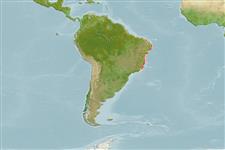
Southwest Atlantic: Brazil.
Bộ gần gũi / Khối lượng (Trọng lượng) / Tuổi
Chín muồi sinh dục: Lm ? range ? - ? cm
Max length : 2.8 cm SL con đực/không giới tính; (Ref. 104557)
Mô tả ngắn gọn
Khóa để định loại | Hình thái học | Sinh trắc học
Các tia vây lưng cứng (tổng cộng) : 7 - 8; Các vây lưng mềm (tổng cộng) : 8 - 11; Tia cứng vây hậu môn: 1; Tia mềm vây hậu môn: 8 - 9. This species is distinguished from its congeners by the following set of characters: scaled body from caudal peduncle to base of pectoral fin, scales in a wedge shape to under posterior of
first dorsal-fin base, continuing anteriorly in a row of 3-4 scales, row slightly tapering anteriorly; naked area extending from mid-pectoral-fin base to 4th-11th ray of second dorsal fin (rarely extending further) and from the mid-pectoral-fin base to 3rd-9th anal-fin ray (rarely extending further); upper jaw 21.5% in head length; lateral scales modally 29; individuals 15 mm SL or larger have 24+ scales; pectoral fin 18 (17-20) (Ref. 104557).
Body shape (shape guide): elongated; Cross section: oval.
Occurs in shallow tidepools which are generally, depressions in the calcareous material with a sand and gravel substrate; tidepool edges covered by algal turf, soft macro-algae, coralline algae and a few soft and hard corals; reef surface generally flat and pools frequently interconnect with each other through both overflows and an extensive system of dissolution holes and channels. The same pools are shared, but not necessarily the same microhabitat, by sympatric gobies which include Bathygobius geminatus Tornabene, Baldwin & Pezold 2010 (most abundant), Bathygobius soporator (Valenciennes 1837), Barbulifer enigmaticus (Joyeux, Van Tassell & Macieira 2009), Coryphopterus glaucofraenum Gill 1863 and Ctenogobius saepepallens (Gilbert & Randall 1968) (least abundant). This species is not limited to the intertidal zone for underwater observations in the state of Alagoas (northeastern Brazil) at about three meters depth (low tide) showed several living on (and in) a rock outcrop located under a reef ledge (the outcrop was composed of encrusting coralline algae, interspersed with filamentous and turf-like algae). Usually, isolated (single) individuals were observed perched at the entrance of a small hole in the calcareous rock, occasionally biting at the substrate, and darting into the hole at the slightest disturbance. An individual was observed, in one occasion, chasing another, both finally entering the same hole and not reappearing during the observation period. In NE Brazil, the state of Paraíba, the species was observed in subtidal areas (about three meters depth) under a small, flat, rounded stone lying on top of a flat clay substrate and upon lifting the stone, the fish disappeared into a small round hole in the substrate. In the state of Espírito Santo, in a 15 cm deep tidepool, this species was observed entering and exiting one of the numerous holes in the clay along the side of the pool. Swimming for this species was limited to close contact with the bottom, in small (1-10 cm) darts, starting and ending in protected areas (i.e., under stones, near holes, into cavities). Also, breeding males were observed perched near holes for extended periods, moving up to 30 cm away, before entering/exiting the hole (Ref. 104557).
Vòng đời và hành vi giao phối
Chín muồi sinh dục | Sự tái sinh sản | Đẻ trứng | Các trứng | Sự sinh sản | Ấu trùng
Van Tassell, J.L., J.-C. Joyeux, R.M. Macieira and L. Tornabene, 2015. Status of Gobiosoma (Teleostei: Gobiidae) from Brazil: description of a new species, redescription of G. hemigymnum, molecular phylogeny of the genus, and key to Atlantic species. Zootaxa 4007(4):451-480. (Ref. 104557)
Tình trạng Sách đỏ IUCN (Ref. 130435: Version 2025-2 (Global))
Mối đe dọa đối với con người
Harmless
Sử dụng của con người
Các công cụ
Báo cáo đặc biệt
Tải xuống XML
Các nguồn internet
Ước tính dựa trên mô hình
Chỉ số đa dạng phát sinh loài (Tài liệu tham khảo
82804): PD
50 = 0.5000 [Uniqueness, from 0.5 = low to 2.0 = high].
Bayesian length-weight: a=0.00741 (0.00347 - 0.01582), b=3.09 (2.91 - 3.27), in cm total length, based on LWR estimates for this (Sub)family-body shape (Ref.
93245).
Mức dinh dưỡng (Tài liệu tham khảo
69278): 3.1 ±0.3 se; based on size and trophs of closest relatives
Thích nghi nhanh (Tài liệu tham khảo
120179): Chiêù cao, thời gian nhân đôi của chủng quần tối thiểu là dưới 15 tháng (Preliminary K or Fecundity.).
Sự dễ bị tổn thương của nghề đánh cá (Ref.
59153): Low vulnerability (10 of 100).
🛈