分类 / 名称
俗名 | 同种异名 | Catalog of Fishes(属, 种) | ITIS | CoL | WoRMS | Cloffa
Teleostei >
Gobiiformes (Gobies) >
Gobiidae (Gobies) > Gobiinae
Etymology: Gobiosoma: Latin, gobius = gudgeon + Greek,soma = body (Ref. 45335); alfiei: Named for Alfredo Carvalho-Filho or Alfie, as he calls himself.
Eponymy: Erasmo Alfredo ‘Alfie’ Amaral de Carvalho-Filho (d: 1950) is a Brazilian ichthyologist at the University of São Paulo Zoological Museum. [...] (Ref. 128868), visit book page.
环境:氛围 / 气候带 / 深度上下限 / 分布范围
生态学
海洋 pelagic-neritic; 深度上下限 0 - 1 m (Ref. 104557).
分布
领土 | FAO区域 | 生态系 | 标本纪录 | 分布图 | 简介 | Faunafri
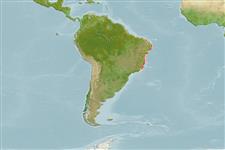
Southwest Atlantic: Brazil.
大小 / 重量 / 年龄
成熟度: Lm ? range ? - ? cm
Max length : 2.8 cm SL 雄鱼/尚未辨别雌雄; (Ref. 104557)
简单描述
检索表 | 型态特徵 | 形态测量图
背棘 (总数) : 7 - 8; 背的软条 (总数) : 8 - 11; 臀棘: 1; 臀鳍软条: 8 - 9. This species is distinguished from its congeners by the following set of characters: scaled body from caudal peduncle to base of pectoral fin, scales in a wedge shape to under posterior of
first dorsal-fin base, continuing anteriorly in a row of 3-4 scales, row slightly tapering anteriorly; naked area extending from mid-pectoral-fin base to 4th-11th ray of second dorsal fin (rarely extending further) and from the mid-pectoral-fin base to 3rd-9th anal-fin ray (rarely extending further); upper jaw 21.5% in head length; lateral scales modally 29; individuals 15 mm SL or larger have 24+ scales; pectoral fin 18 (17-20) (Ref. 104557).
Body shape (shape guide): elongated; Cross section: oval.
Occurs in shallow tidepools which are generally, depressions in the calcareous material with a sand and gravel substrate; tidepool edges covered by algal turf, soft macro-algae, coralline algae and a few soft and hard corals; reef surface generally flat and pools frequently interconnect with each other through both overflows and an extensive system of dissolution holes and channels. The same pools are shared, but not necessarily the same microhabitat, by sympatric gobies which include Bathygobius geminatus Tornabene, Baldwin & Pezold 2010 (most abundant), Bathygobius soporator (Valenciennes 1837), Barbulifer enigmaticus (Joyeux, Van Tassell & Macieira 2009), Coryphopterus glaucofraenum Gill 1863 and Ctenogobius saepepallens (Gilbert & Randall 1968) (least abundant). This species is not limited to the intertidal zone for underwater observations in the state of Alagoas (northeastern Brazil) at about three meters depth (low tide) showed several living on (and in) a rock outcrop located under a reef ledge (the outcrop was composed of encrusting coralline algae, interspersed with filamentous and turf-like algae). Usually, isolated (single) individuals were observed perched at the entrance of a small hole in the calcareous rock, occasionally biting at the substrate, and darting into the hole at the slightest disturbance. An individual was observed, in one occasion, chasing another, both finally entering the same hole and not reappearing during the observation period. In NE Brazil, the state of Paraíba, the species was observed in subtidal areas (about three meters depth) under a small, flat, rounded stone lying on top of a flat clay substrate and upon lifting the stone, the fish disappeared into a small round hole in the substrate. In the state of Espírito Santo, in a 15 cm deep tidepool, this species was observed entering and exiting one of the numerous holes in the clay along the side of the pool. Swimming for this species was limited to close contact with the bottom, in small (1-10 cm) darts, starting and ending in protected areas (i.e., under stones, near holes, into cavities). Also, breeding males were observed perched near holes for extended periods, moving up to 30 cm away, before entering/exiting the hole (Ref. 104557).
生命周期和交配行为
成熟度 | 繁殖 | 产卵场 | 卵 | 孕卵数 | 仔鱼
Van Tassell, J.L., J.-C. Joyeux, R.M. Macieira and L. Tornabene, 2015. Status of Gobiosoma (Teleostei: Gobiidae) from Brazil: description of a new species, redescription of G. hemigymnum, molecular phylogeny of the genus, and key to Atlantic species. Zootaxa 4007(4):451-480. (Ref. 104557)
世界自然保护联盟红皮书 (Ref. 130435: Version 2025-2 (Global))
人类利用
工具
特别资料
下载 XML
网络资源
基于模型的估算
系统发育多样性指数 (参考文献
82804): PD
50 = 0.5000 [Uniqueness, from 0.5 = low to 2.0 = high].
Bayesian length-weight: a=0.00741 (0.00347 - 0.01582), b=3.09 (2.91 - 3.27), in cm total length, based on LWR estimates for this (Sub)family-body shape (Ref.
93245).
营养阶层 (参考文献
69278): 3.1 ±0.3 se; based on size and trophs of closest relatives
回复力 (参考文献
120179): 高度, 族群倍增时间少于 15个月 (Preliminary K or Fecundity.).
渔业脆弱性 (Ref.
59153): Low vulnerability (10 of 100).
🛈