Classification / Noms
Noms communs | Synonymes | Catalog of Fishes(Genre, Espèce) | ITIS | CoL | WoRMS | Cloffa
>
Ovalentaria/misc (Various families in series Ovalentaria) >
Polycentridae (Leaffishes)
Etymology: Polycentrus: Greek, poly = a lot of + Greek, kentron = sting (Ref. 45335); jundia: The specific name is derived from the Tupi word 'jundiá' meaning 'head with spine', and refers to the large amount of serrations present on the head bones of the new species. A noun in apposition.
Environnement : milieu / zone climatique / profondeur / gamme de distribution
Écologie
; eau douce benthopélagique. Tropical
South America: Rio Negro basin in Brazil.
Taille / Poids / Âge
Maturité: Lm ? range ? - ? cm
Max length : 2.8 cm SL mâle / non sexé; (Ref. 102655)
Description synthétique
Clés d'identification | Morphologie | Morphométrie
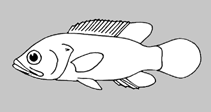
Épines dorsales (Total) : 15 - 16; Rayons mous dorsaux (Total) : 7 - 9; Épines anales: 11 - 12; Rayons mous anaux: 5 - 6. Polycentrus jundia can be distinguished from P. schomburgkii by the following characters: diagonal upper postorbital band being shorter than orbital diameter (vs. longer); median postorbital horizontal band present (vs. absent); subocular band being shorter than orbital diameter (vs. length of subocular band equal to or greater than orbital diameter; snout blunt (vs. protruding); mouth isognathous (vs. prognathous); serrations absent on lower edge of lacrimal or two tiny serrations at the posterior
end (vs. 8-14 conspicuous serrations distributed throughout the lower edge); posterior edge of vertical arm of preopercle fully serrated (vs. smooth edge); five pungent opercular spines, the three dorsalmost largest (vs. one or two short spines); subopercle widely serrated along most of the edge (vs. no serrations); cleithrum with serrations on posterior dorsal margin (vs. no serrations); interopercle with widely serrated edge (vs. clusters of three to five serrations along the edge of varying position between individuals); fourth pectoral-fin ray reaching vertical through anal-fin origin (vs. reaching vertical from spine III or IV of anal fin); 19-20 scales on dorsal-fin base (vs. 26-31); 12-14 scales on anal-fin base (vs. 16-20); 19-21 predorsal scales (vs. 28-30); and median opercular blotch absent (vs. present) (Ref. 102655).
Cycle de vie et comportement reproducteur
Maturité | Reproduction | Frai | Œufs | Fécondité | Larves
Coutinho, D.P. and W.B. Wosiacki, 2014. A new species of leaffish Polycentrus Müller & Troschel, 1849 (Percomorpha: Polycentridae) from the rio Negro, Brazil. Neotrop. Ichthyol. 12(4):747-753. (Ref. 102655)
Statut dans la liste rouge de l'IUCN (Ref. 130435: Version 2025-2 (Global))
Menace pour l'homme
Harmless
Utilisations par l'homme
Outils
Articles particuliers
Télécharger en XML
Sources Internet
Estimations basées sur des modèles
Indice de diversité phylogénétique (Réf.
82804): PD
50 = 0.7812 [Uniqueness, from 0.5 = low to 2.0 = high].
Bayesian length-weight: a=0.01122 (0.00514 - 0.02450), b=3.04 (2.87 - 3.21), in cm total length, based on all LWR estimates for this body shape (Ref.
93245).
Niveau trophique (Réf.
69278): 3.3 ±0.5 se; based on size and trophs of closest relatives
Vulnérabilité de la pêche (Ref.
59153): Low vulnerability (10 of 100).
🛈