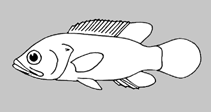
klasifikasi / Nama
Nama-nama umum | Sinonim (persamaan) | Catalog of Fishes(Marga, Jenis) | ITIS | CoL | WoRMS | Cloffa
>
Ovalentaria/misc (Various families in series Ovalentaria) >
Polycentridae (Leaffishes)
Etymology: Polycentrus: Greek, poly = a lot of + Greek, kentron = sting (Ref. 45335); jundia: The specific name is derived from the Tupi word 'jundiá' meaning 'head with spine', and refers to the large amount of serrations present on the head bones of the new species. A noun in apposition.
Lingkungan: lingkungan / zona iklim / kisaran kedalaman / jangkauan distribusi
Ekologi
; air tawar bentopelagis. Tropical
South America: Rio Negro basin in Brazil.
Ukuran / Berat / umur
Kematangan: Lm ? range ? - ? cm
Max length : 2.8 cm SL jantan/; (Ref. 102655)
deskripsi pendek
Kunci identifiaksi (pengenalan) | Morfologi | Morfometrik
Duri punggung (Keseluruhan (total)) : 15 - 16; duri punggung lunak (Keseluruhan (total)) : 7 - 9; Duri dubur: 11 - 12; Sirip dubur lunak: 5 - 6. Polycentrus jundia can be distinguished from P. schomburgkii by the following characters: diagonal upper postorbital band being shorter than orbital diameter (vs. longer); median postorbital horizontal band present (vs. absent); subocular band being shorter than orbital diameter (vs. length of subocular band equal to or greater than orbital diameter; snout blunt (vs. protruding); mouth isognathous (vs. prognathous); serrations absent on lower edge of lacrimal or two tiny serrations at the posterior
end (vs. 8-14 conspicuous serrations distributed throughout the lower edge); posterior edge of vertical arm of preopercle fully serrated (vs. smooth edge); five pungent opercular spines, the three dorsalmost largest (vs. one or two short spines); subopercle widely serrated along most of the edge (vs. no serrations); cleithrum with serrations on posterior dorsal margin (vs. no serrations); interopercle with widely serrated edge (vs. clusters of three to five serrations along the edge of varying position between individuals); fourth pectoral-fin ray reaching vertical through anal-fin origin (vs. reaching vertical from spine III or IV of anal fin); 19-20 scales on dorsal-fin base (vs. 26-31); 12-14 scales on anal-fin base (vs. 16-20); 19-21 predorsal scales (vs. 28-30); and median opercular blotch absent (vs. present) (Ref. 102655).
Siklus hidup dan perilaku kawin
Kematangan | Reproduksi, perkembang biakan | Pemijahan | telur-telur | Fekunditas | Larva
Coutinho, D.P. and W.B. Wosiacki, 2014. A new species of leaffish Polycentrus Müller & Troschel, 1849 (Percomorpha: Polycentridae) from the rio Negro, Brazil. Neotrop. Ichthyol. 12(4):747-753. (Ref. 102655)
Status IUCN Red List (Ref. 130435: Version 2025-2 (Global))
ancaman kepada manusia
Harmless
penggunaan manusia
Alat, peralatan
laporan khas
muat turun XML
Sumber internet
Estimasi berdasarkan model
Indeks keanekaragaman filogenetik (Acuan
82804): PD
50 = 0.7812 [Uniqueness, from 0.5 = low to 2.0 = high].
Bayesian length-weight: a=0.01122 (0.00514 - 0.02450), b=3.04 (2.87 - 3.21), in cm total length, based on all LWR estimates for this body shape (Ref.
93245).
Tingkat Trofik (Acuan
69278): 3.3 ±0.5 se; based on size and trophs of closest relatives
Kerentanan Penangkapan Ikan (Ref.
59153): Low vulnerability (10 of 100).
🛈