Ταξινόμηση / Ονόματα
Κοινά ονόματα | Συνώνυμα | Catalog of Fishes(Γένος, Είδη) | ITIS | CoL | WoRMS | Cloffa
>
Siluriformes (Catfishes) >
Loricariidae (Armored catfishes) > Hypostominae
Etymology: Hypostomus: Greek, hypo = under + Greek, stoma = mouth (Ref. 45335); khimaera: Derived from the Greek, cimaira or khímaira, a mythological creature with hybrid body, formed
essentially by three animals, a lion, a snake and a goat. The specific name khimaera makes an allusion due to the new species possess features of conspicuously distinct species. A noun in apposition.
Eponymy: From Greek mythology, the Khimaera (or Chimera) was a creature with a hybrid body formed by three animals (lion, goat, snake). The name was chosen because the catfish possesses features of conspicuously distinct species. (Ref. 128868), visit book page.
Περιβάλλον: περιβάλλον / κλιματική ζώνη / εύρος βάθους / εύρος διανομής
Οικολογία
; Γλυκού νερού βενθικό(ς). Tropical
South America: Rio Paraguay basin in Brazil.
Μέγεθος / Βάρος / Ηλικία
Γεννητική Ωρίμανση: Lm ? range ? - ? cm
Max length : 16.4 cm SL αρσενικό/απροσδιόριστο; (Ref. 97225)
Σύντομη περιγραφή
Κλείδες προσδιορισμού | Μορφολογία | Μορφομετρία
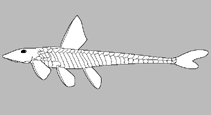
Ραχιαίες άκανθες (συνολικά) : 2; Μαλακές ραχιαίες ακτίνες (συνολικά) : 7; Μαλακές εδρικές ακτίνες: 5. Hypostomus khimaera can be diagnosed from all congeners, except those belonging to the H. cochliodon group, by having the following unique combination of characters: absence of notch between metapterygoid and hyomandibula (vs. presence of notch); and strongly angled dentaries, less than 80° (vs. shallow angle between dentaries, generally more than 80°). It differs from all members of the H. cochliodon group, except from H. basilisko and H. soniae, by the presence of a dark tan stripe along the flank (vs. absence). It can be distinguished from H. basilisko and H. soniae by having black spots on the body and fins or at least in one of these (vs. absence of spots). In addition, it can be further separated from H. basilisko by having moderately developed keels (vs. highly developed keels) and 28 vertebrae (vs. 27); and from H. cochliodon by having 12-27 teeth (vs. 7-9), externalized opercle, exposed region easily visible (vs. almost entire internalized opercle, exposed region not easily visible; and 28 vertebrae (vs. 29) (Ref. 97225).
Body shape (shape guide): elongated.
Facultative air-breathing in the genus (Ref. 126274); Syntopic with Hypostomus cochliodon in several localities of rio Paraguay basin. Commonly found in small streams than in larger streams. Generally collected along the
margins of deeper sites with sandy bottoms in the rio Aquidauana basin streams (Ref. 97225).
Κύκλος ζωής και συμπεριφορά ζευγαρώματος
Γεννητική Ωρίμανση | Αναπαραγωγή | Γεννοβολία | Αβγά | Γονιμότητα | Προνύμφες
Tencatt, L.F.C., C.H. Zawadzki and O. Froehlich, 2014. Two new species of the Hypostomus cochliodon group (Siluriformes: Loricariidae) from the rio Paraguay basin, with a redescription of Hypostomus cochliodon Kner, 1854. Neotrop. Ichthyol. 12(3):585-602. (Ref. 97225)
Κατάσταση Κόκκινου Καταλόγου IUCN (Ref. 130435: Version 2025-2 (Global))
Απειλή για τον άνθρωπο
Harmless
Ανθρώπινες χρήσεις
αλιεία: χωρίς ενδιαφέρον
Εργαλεία
Ειδικές εκθέσεις
Λήψη XML
Διαδικτυακές πηγές
Εκτιμήσεις βάσει μοντέλων
Δείκτης φυλογενετικής ποικιλότητας (Αναφ.
82804): PD
50 = 0.5000 [Uniqueness, from 0.5 = low to 2.0 = high].
Bayesian length-weight: a=0.01585 (0.00726 - 0.03460), b=2.95 (2.78 - 3.12), in cm total length, based on LWR estimates for this Genus-body shape (Ref.
93245).
Ελαστικότητα (Αναφ.
120179): Μεσαίο(α), ελάχιστος χρόνος για διπλασιασμό πληθυσμού 1,4 - 4,4 έτη (Preliminary K or Fecundity.).
Ευπάθεια στην αλιεία (Ref.
59153): Low vulnerability (10 of 100).
🛈