رده بندی / نامها
اسامي عام | مترادف | Catalog of Fishes(جنس, گونه ها) | ITIS | CoL | WoRMS | Cloffa
>
Siluriformes (Catfishes) >
Loricariidae (Armored catfishes) > Hypostominae
Etymology: Hypostomus: Greek, hypo = under + Greek, stoma = mouth (Ref. 45335); khimaera: Derived from the Greek, cimaira or khímaira, a mythological creature with hybrid body, formed
essentially by three animals, a lion, a snake and a goat. The specific name khimaera makes an allusion due to the new species possess features of conspicuously distinct species. A noun in apposition.
Eponymy: From Greek mythology, the Khimaera (or Chimera) was a creature with a hybrid body formed by three animals (lion, goat, snake). The name was chosen because the catfish possesses features of conspicuously distinct species. (Ref. 128868), visit book page.
محیط زیست: محیط زیست / منطقه آب و هوایی / تغييرات عمق / محدوده توزیع
بوم شناسي
; آب شيرين نزديك كف زي. Tropical
South America: Rio Paraguay basin in Brazil.
اندازه / وزن / سن
بلوغ: Lm ? range ? - ? cm
Max length : 16.4 cm SL جنس نر / بدون خواص جنسي; (Ref. 97225)
توصيف مختصر
كليدهاي شناسايي | ريخت شناسي | ريخت ستجي بوسيله انداره گيري
خارهاي باله پشتي (کل) : 2; شعاع نرم باله پشتي (کل) : 7; شعاع نرم باله مخرجي: 5. Hypostomus khimaera can be diagnosed from all congeners, except those belonging to the H. cochliodon group, by having the following unique combination of characters: absence of notch between metapterygoid and hyomandibula (vs. presence of notch); and strongly angled dentaries, less than 80° (vs. shallow angle between dentaries, generally more than 80°). It differs from all members of the H. cochliodon group, except from H. basilisko and H. soniae, by the presence of a dark tan stripe along the flank (vs. absence). It can be distinguished from H. basilisko and H. soniae by having black spots on the body and fins or at least in one of these (vs. absence of spots). In addition, it can be further separated from H. basilisko by having moderately developed keels (vs. highly developed keels) and 28 vertebrae (vs. 27); and from H. cochliodon by having 12-27 teeth (vs. 7-9), externalized opercle, exposed region easily visible (vs. almost entire internalized opercle, exposed region not easily visible; and 28 vertebrae (vs. 29) (Ref. 97225).
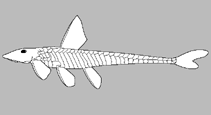
Body shape (shape guide): elongated.
Facultative air-breathing in the genus (Ref. 126274); Syntopic with Hypostomus cochliodon in several localities of rio Paraguay basin. Commonly found in small streams than in larger streams. Generally collected along the
margins of deeper sites with sandy bottoms in the rio Aquidauana basin streams (Ref. 97225).
چرخه زندگی و رفتار جفتگیری
بلوغ | تولید مثل | تخم ریزی | تخم ها | باروری | توزاد ( لارو)
Tencatt, L.F.C., C.H. Zawadzki and O. Froehlich, 2014. Two new species of the Hypostomus cochliodon group (Siluriformes: Loricariidae) from the rio Paraguay basin, with a redescription of Hypostomus cochliodon Kner, 1854. Neotrop. Ichthyol. 12(3):585-602. (Ref. 97225)
وضعيت در فهرست قرمز IUCN (Ref. 130435: Version 2025-2 (Global))
خطر برای انسان ها
Harmless
استفاده انسانی
ماهي گيري – شيلات: از بی علاقه گی
ابزارها
گزارش های ويژه
بارگيری XML
منابع اينترنتي
تخمینها بر اساس مدلها
شاخص تنوع فیلوژنتیکی (مرجع
82804): PD
50 = 0.5000 [Uniqueness, from 0.5 = low to 2.0 = high].
Bayesian length-weight: a=0.01585 (0.00726 - 0.03460), b=2.95 (2.78 - 3.12), in cm total length, based on LWR estimates for this Genus-body shape (Ref.
93245).
جهندگی (مرجع
120179): متوسط, كمينه زمان لازم براي دو برابر شدن جمعيت 4/1 – 4/4 سال (Preliminary K or Fecundity.).
آسیبپذیری ماهیگیری (Ref.
59153): Low vulnerability (10 of 100).
🛈