This website uses cookies to enhance your browsing experience and ensure the functionality of our site. For more detailed information about the types of cookies we use and how we protect your privacy, please visit our Privacy Information page.
×
Cookie Settings
This website uses different types of cookies to enhance your experience. Please select your preferences below:
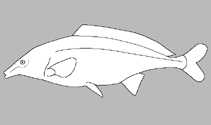
No image available for this species; drawing shows typical species in Mormyridae.
分類 / 名稱 俗名 | 同種異名 | Catalog of Fishes(屬, 種) | ITIS | CoL | WoRMS | Cloffa
Teleostei > Osteoglossiformes (Bony tongues) 骨舌魚目 (Bony tongues) > Mormyridae (Elephantfishes) 象鼻魚科 (Elephantfishes)
Etymology: Pollimyrus:Because of Dr. Max Poll, ichthyologist + Greek, myros, -ou = the male of the morey eel; cuandoensis:The species name cuandoensis refers to the Kwando (Cuando) River that passes through the Caprivi Strip, Namibia (Ref. 94890). Eponymy: Dr Max Fernand Leon Poll (1908–1991) was a Belgian ichthyologist, and ‘connoisseur of the fish fauna’. [...] (Ref. 128868), visit book page.
背棘 (總數) : 0; 背的軟條 (總數) : 15 - 18; 臀棘: 0; 臀鰭軟條: 21 - 24. Diagnosis: Number of scales around caudal peduncle 12-16, predorsal length63.3-68.5% of standard length, dorsal fin length 14.0-18.1% of standard length, anal fin length 18.0-24.1% of standard length, distance from pectoral fin origin to pelvic fin origin 15.0-18.7% of standard length, caudal peduncle length 18.9-24.0% of standard length, caudal peduncle depth 32.1-41.4% of caudal peduncle length, length of snout 40.5-50.0% of head length, body depth 24.6-30.5% of standard length, dorsal fin rays 15-18, anal fin rays 21-24, scales in linear series along lateral line row 44-55, distance from tip of snout to anal fin origin 58.4-63.4% of standard length, length of pectoral fin 76.3-92.5% of head length, distance from dorsal fin origin to end of caudal peduncle 37.9-42.6% of standard length, eye diameter 23.7-30.5% of head length, head length 22.5-26.3% of standard length, and distance between the pair of nares of one side 8.31-9.92 times in head length (Ref. 94890). Electric organ discharge with 5 phases and last phase P2 not stronger than P1 (Ref. 94890).
Body shape (shape guide): elongated; Cross section: compressed.
This species prefers to hide in weeds if present, floating or not, often high up in water column, sometimes even at the surface under a water lily leaf in bright sunlight; also found on rocky bottom, hiding in crevices and holes (Ref. 94890). It will often not struggle in weeds brought to shore, so as not to raise attention (Ref. 94890).
Kramer, B., H. van der Bank and M. Wink, 2013. Marked differentiation in a new species of dwarf stonebasher, Pollimyrus cuandoensis sp. nov. (Mormyridae: Teleostei), from a contact zone with two sibling species of the Okavango and Zambezi rivers. J. Nat. Hist. 48(7-8):429-463. (Ref. 94890)
系統發育多樣性指數 (參考文獻 82804): PD50 = 0.5000 [Uniqueness, from 0.5 = low to 2.0 = high].
Bayesian length-weight: a=0.00562 (0.00248 - 0.01273), b=3.05 (2.85 - 3.25), in cm total length, based on LWR estimates for this (Sub)family-body shape (Ref. 93245).
營養階層 (參考文獻 69278): 3.2 ±0.3 se; based on size and trophs of closest relatives
回復力 (參考文獻 120179): 高度, 族群倍增時間少於 15個月 (Preliminary K or Fecundity.).
釣魚的脆弱性 (Ref. 59153): Low vulnerability (10 of 100). 🛈