>
Osteoglossiformes (Bony tongues) >
Mormyridae (Elephantfishes)
Etymology: Pollimyrus: Because of Dr. Max Poll, ichthyologist + Greek, myros, -ou = the male of the morey eel; cuandoensis: The species name cuandoensis refers to the Kwando (Cuando) River that passes through the Caprivi Strip, Namibia (Ref. 94890).
Eponymy: Dr Max Fernand Leon Poll (1908–1991) was a Belgian ichthyologist, and ‘connoisseur of the fish fauna’. [...] (Ref. 128868), visit book page.
Lingkungan: lingkungan / zona iklim / kisaran kedalaman / jangkauan distribusi
Ekologi
; air tawar bentopelagis. Tropical
Africa: lower section of Kwando River, Caprivi Strip, Namibia (Ref. 94890). Also reported from the Angolan Zambezi basin (Ref. 120641).
Ukuran / Berat / umur
Kematangan: Lm ? range ? - ? cm
Max length : 6.5 cm SL jantan/; (Ref. 94890)
deskripsi pendek
Kunci identifiaksi (pengenalan) | Morfologi | Morfometrik
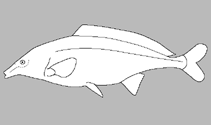
Duri punggung (Keseluruhan (total)) : 0; duri punggung lunak (Keseluruhan (total)) : 15 - 18; Duri dubur: 0; Sirip dubur lunak: 21 - 24. Diagnosis: Number of scales around caudal peduncle 12-16, predorsal length63.3-68.5% of standard length, dorsal fin length 14.0-18.1% of standard length, anal fin length 18.0-24.1% of standard length, distance from pectoral fin origin to pelvic fin origin 15.0-18.7% of standard length, caudal peduncle length 18.9-24.0% of standard length, caudal peduncle depth 32.1-41.4% of caudal peduncle length, length of snout 40.5-50.0% of head length, body depth 24.6-30.5% of standard length, dorsal fin rays 15-18, anal fin rays 21-24, scales in linear series along lateral line row 44-55, distance from tip of snout to anal fin origin 58.4-63.4% of standard length, length of pectoral fin 76.3-92.5% of head length, distance from dorsal fin origin to end of caudal peduncle 37.9-42.6% of standard length, eye diameter 23.7-30.5% of head length, head length 22.5-26.3% of standard length, and distance between the pair of nares of one side 8.31-9.92 times in head length (Ref. 94890). Electric organ discharge with 5 phases and last phase P2 not stronger than P1 (Ref. 94890).
Body shape (shape guide): elongated; Cross section: compressed.
This species prefers to hide in weeds if present, floating or not, often high up in water column, sometimes even at the surface under a water lily leaf in bright sunlight; also found on rocky bottom, hiding in crevices and holes (Ref. 94890). It will often not struggle in weeds brought to shore, so as not to raise attention (Ref. 94890).
Siklus hidup dan perilaku kawin
Kematangan | Reproduksi, perkembang biakan | Pemijahan | telur-telur | Fekunditas | Larva
Kramer, B., H. van der Bank and M. Wink, 2013. Marked differentiation in a new species of dwarf stonebasher, Pollimyrus cuandoensis sp. nov. (Mormyridae: Teleostei), from a contact zone with two sibling species of the Okavango and Zambezi rivers. J. Nat. Hist. 48(7-8):429-463. (Ref. 94890)
Status IUCN Red List (Ref. 130435: Version 2025-2 (Global))
ancaman kepada manusia
Harmless
penggunaan manusia
Alat, peralatan
laporan khas
muat turun XML
Sumber internet
Estimasi berdasarkan model
Indeks keanekaragaman filogenetik (Acuan
82804): PD
50 = 0.5000 [Uniqueness, from 0.5 = low to 2.0 = high].
Bayesian length-weight: a=0.00562 (0.00248 - 0.01273), b=3.05 (2.85 - 3.25), in cm total length, based on LWR estimates for this (Sub)family-body shape (Ref.
93245).
Tingkat Trofik (Acuan
69278): 3.2 ±0.3 se; based on size and trophs of closest relatives
Daya lenting (Acuan
120179): Tinggi, Waktu penggandaan populasi minimum kurang dari 15 bulan (Preliminary K or Fecundity.).
Kerentanan Penangkapan Ikan (Ref.
59153): Low vulnerability (10 of 100).
🛈