التصنيف / الأسماء
الأسماء الشائعة | مرادفات | Catalog of Fishes(جنس, الانواع) | ITIS | CoL | WoRMS | Cloffa
>
Perciformes/Percoidei (Perchs) >
Percidae (Perches) > Etheostomatinae
Etymology: starnesi: Named for ichthyologist Wayne C. Starnes, Curator of Fishes and Director of the Research Lab at the North Carolina Museum of Natural Sciences.
Eponymy: Dr Wayne C Starnes is a zoologist interested in evolutionary biology, systematics and genetics. [...] (Ref. 128868), visit book page.
البيئة: الوسط / المنطقة المناخية / نطاق العمق / نطاق التوزيع
البيئة
; المياه العذبة قاعية التغذية و المعيشة. Subtropical
North America: USA.
الطول عند النضج الأول / الحجم / وزن / العمر
النضج: Lm 5.3, range 5 - 6 cm
Max length : 7.6 cm SL ذكر/ مختلط الجنس; (Ref. 93269)
وصف مختصر
مفاتيح التعريف | الوصف الخارجي | قياسات المظهر الخارجي
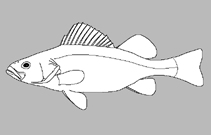
الأشواك الظهرية (المجموع) : 12 - 14; الأشعة الظهرية الناعمة (المجموع) : 10 - 13; شوكة شرجية: 2; أشعه شرجية لينه: 7 - 9. This species belonging to the N. maculatus species group have scales associated with the postorbital spot on the cheek and show breeding behavior in which males guard clumps of eggs in crevices under rocks (vs. having a completely unscaled cheek and burying clumps of eggs in substrate with no subsequent care in all other species of Nothonotus<>). Within the species group, N. starnesi and N. sanguifluus differs from all other species on the basis of pigmentation patterns, males have red pigmentation covering a high proportion of all the median fins (vs. green median fins in N. wapiti and N. microlepidus; greenish blue anal and pelvic fins in N. vulneratus and N. maculatus); and, the presence of a suborbital bar (vs. absent in Nothonotus aquali). Male nuptial coloration of N. starnesi tends to have less-pronounced darkening of pigment at the base of the first three interradial membranes of the spinous dorsal fin and in the pelvic fins, has much more discrete and contrasting vermiculation on the head and cheek, and has more red in the pectoral fins when compared with N. sanguifluus. In addition, N. starnesi have lower mean numbers for pored lateral line scales, scales below the lateral line, and scales in the most ventral row of the opercle (Ref. 93269).
This species is found to be most abundant in the faster-flowing riffles of medium to large streams; substrate in these riffles is mostly large cobble and small boulders that is not embedded. Adults and juveniles are found in the same riffles, but smaller individuals tend to be more common near the banks of the streams. N. starnesi is expected to spawn in a manner similar to other members of the N. maculatus species group, with the males guarding a nest site under a larger cobble in fast current and eggs deposited in a clump in the crevice under the cobble. During the dryer, summer months, the surface flow of several eastern Caney Fork tributaries flowing over the more karst-like areas completely disappears, creating a series of isolated pools with little or no observable current. During these times, the species have only been observed in patches of silt-free substrate along the margins of the pool, presumably indicating areas of subsurface water upwelling. Gravid females are observed from May through July (Ref. 93269).
دورة الحياة وسلوك التزاوج
النضج | التكاثر | وضع البيض | بيض | الخصوبة | اليرقات
Keck, B.P. and T.J. Near, 2013. A new species of Nothonotus Darter (Teleostei: Percidae) from the Caney Fork in Tennessee, USA. Bulletin of the Peabody Museum of Natural History 54(1):3-21. (Ref. 93269)
حالة القائمة الحمراء للاتحاد الدولي لحفظ الطبيعة والموارد الطبيعية (Ref. 130435: Version 2025-2 (Global))
استخدامات بشرية
أدوات
تقارير خاصة
تنزيل XML
مصادر علي الأنترنت
تقديرات تستند إلى النماذج
مؤشر التنوع الشُعبي الوراثي (مرجع
82804): PD
50 = 0.5625 [Uniqueness, from 0.5 = low to 2.0 = high].
Bayesian length-weight: a=0.00575 (0.00268 - 0.01234), b=3.13 (2.95 - 3.31), in cm total length, based on LWR estimates for this (Sub)family-body shape (Ref.
93245).
مستوى غذائي (مرجع
69278): 3.3 ±0.5 se; based on size and trophs of closest relatives
المرونه (مرجع
120179): عالي, الحد الزمني الأدني لتضاعف عدد أفراد المجتمع أقل من 15 شهر (Preliminary K or Fecundity.).
ضعف الصيد (Ref.
59153): Low vulnerability (10 of 100).
🛈