分類 / 名前
共通名の | 類義語 | Catalog of Fishes(部類, 種) | ITIS | CoL | WoRMS | Cloffa
>
Cypriniformes (Carps) >
Cobitidae (Spined loaches)
Etymology: Cobitis: Greek, kobitis, -idos = a kind of sardine; also related with the voice Greek, kobios, Latin gobius = gudgeon (Ref. 45335); minamorii: The specific name is dedicated to Dr. Sumio Minamori who was the pioneer of the study of speciation of loaches in Japan (Ref 92393).
Eponymy: Dr Sumio Minamori (d: 1917) was a Japanese biologist and geneticist at the Zoological Laboratory, Faculty of Science, Hiroshima University, Japan. [...] (Ref. 128868), visit book page.
環境:環境 / 気候帯 / 深さの範囲 / 分布範囲
生態学
; 新鮮な水 底生の漂泳性. Subtropical
Asia: Japan in Okayama, Hiroshima, Shiga, Shizuoka, Gifu, Aichi, Mie, Hyogo, Tottori, Shimane, Kyoto and Osaka Prefectures.
サイズ / 重さ / 年齢
成熟: Lm ? range ? - ? cm
Max length : 6.2 cm SL オス/雌雄の選別がない; (Ref. 92393); 7.4 cm SL (female)
簡単な記述
検索表 | 形態学 | 形態計測学
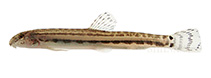
Distinguishable from other Japanese striated spined loaches by the following characteristics: body size small, the mature size about 35-45 mm SL in males, 45-55 mm SL in females; lamina circularis at the base of the pectoral fin of adult male a roundish plate, somewhat narrowing toward the outer part; upper segments of the first branched soft ray of pectoral fin narrow and weak; PMN commonly 12; snout short; eye diameter relatively large; body depth and caudal peduncle relatively deep; line L1 consisting of a series of 15-25 blotches; blotches saddle or oval-shaped; line L2 formed by longitudinal jagged line or angular blotches, reaching to pre- or middorsal region, often fused with L1; line L3 formed by incomplete longitudinal narrow line, reaching beyond dorsal fin; line L5 formed by narrow incomplete longitudinal line or organized in chained tiny 15-20 blotches; caudal and dorsal fin with 3-4 irregular vertical bars and exterior bar weak margined; upper spot at the caudal base black, smaller than eye diameter; lower spot at caudal base existing but faint; each spots not connected; egg yolk diameter approximately 0.8 mm; karyotype diploid (2n = 49 in male, 50 in female) (Ref. 92393).
Body shape (shape guide): elongated.
ライフサイクルと交尾行動
成熟 | 繁殖 | 放精 | 卵 | 生産力 | 幼生
Nakajima, J., 2012. Taxonomic study of the Cobitis striata complex (Cypriniformes, Cobitidae) in Japan. Zootaxa 3586:103-130. (Ref. 92393)
IUCNのレッドリストの状況は (Ref. 130435: Version 2025-2 (Global))
絶滅危惧に近い (NT) (B2ab(i,ii,iii,iv,v)); Date assessed: 08 December 2017
人間の用途
用具
特記事項
XMLをダウンロードして下さい
インターネットの情報源
モデルに基づく推定値
系統多様性指数 (参照
82804): PD
50 = 0.5000 [Uniqueness, from 0.5 = low to 2.0 = high].
Bayesian length-weight: a=0.00513 (0.00231 - 0.01140), b=3.09 (2.92 - 3.26), in cm total length, based on LWR estimates for this Genus-body shape (Ref.
93245).
栄養段階 (参照
69278): 3.2 ±0.4 se; based on size and trophs of closest relatives
漁業の脆弱性 (Ref.
59153): Low vulnerability (10 of 100).
🛈