Classification / Noms
Noms communs | Synonymes | Catalog of Fishes(Genre, Espèce) | ITIS | CoL | WoRMS | Cloffa
>
Cypriniformes (Carps) >
Cobitidae (Spined loaches)
Etymology: Cobitis: Greek, kobitis, -idos = a kind of sardine; also related with the voice Greek, kobios, Latin gobius = gudgeon (Ref. 45335); minamorii: The specific name is dedicated to Dr. Sumio Minamori who was the pioneer of the study of speciation of loaches in Japan (Ref 92393).
Eponymy: Dr Sumio Minamori (d: 1917) was a Japanese biologist and geneticist at the Zoological Laboratory, Faculty of Science, Hiroshima University, Japan. [...] (Ref. 128868), visit book page.
Environnement : milieu / zone climatique / profondeur / gamme de distribution
Écologie
; eau douce benthopélagique. Subtropical
Asia: Japan in Okayama, Hiroshima, Shiga, Shizuoka, Gifu, Aichi, Mie, Hyogo, Tottori, Shimane, Kyoto and Osaka Prefectures.
Taille / Poids / Âge
Maturité: Lm ? range ? - ? cm
Max length : 6.2 cm SL mâle / non sexé; (Ref. 92393); 7.4 cm SL (female)
Description synthétique
Clés d'identification | Morphologie | Morphométrie
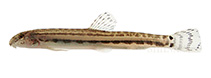
Distinguishable from other Japanese striated spined loaches by the following characteristics: body size small, the mature size about 35-45 mm SL in males, 45-55 mm SL in females; lamina circularis at the base of the pectoral fin of adult male a roundish plate, somewhat narrowing toward the outer part; upper segments of the first branched soft ray of pectoral fin narrow and weak; PMN commonly 12; snout short; eye diameter relatively large; body depth and caudal peduncle relatively deep; line L1 consisting of a series of 15-25 blotches; blotches saddle or oval-shaped; line L2 formed by longitudinal jagged line or angular blotches, reaching to pre- or middorsal region, often fused with L1; line L3 formed by incomplete longitudinal narrow line, reaching beyond dorsal fin; line L5 formed by narrow incomplete longitudinal line or organized in chained tiny 15-20 blotches; caudal and dorsal fin with 3-4 irregular vertical bars and exterior bar weak margined; upper spot at the caudal base black, smaller than eye diameter; lower spot at caudal base existing but faint; each spots not connected; egg yolk diameter approximately 0.8 mm; karyotype diploid (2n = 49 in male, 50 in female) (Ref. 92393).
Body shape (shape guide): elongated.
Cycle de vie et comportement reproducteur
Maturité | Reproduction | Frai | Œufs | Fécondité | Larves
Nakajima, J., 2012. Taxonomic study of the Cobitis striata complex (Cypriniformes, Cobitidae) in Japan. Zootaxa 3586:103-130. (Ref. 92393)
Statut dans la liste rouge de l'IUCN (Ref. 130435: Version 2025-2 (Global))
Menace pour l'homme
Harmless
Utilisations par l'homme
Outils
Articles particuliers
Télécharger en XML
Sources Internet
Estimations basées sur des modèles
Indice de diversité phylogénétique (Réf.
82804): PD
50 = 0.5000 [Uniqueness, from 0.5 = low to 2.0 = high].
Bayesian length-weight: a=0.00513 (0.00231 - 0.01140), b=3.09 (2.92 - 3.26), in cm total length, based on LWR estimates for this Genus-body shape (Ref.
93245).
Niveau trophique (Réf.
69278): 3.2 ±0.4 se; based on size and trophs of closest relatives
Vulnérabilité de la pêche (Ref.
59153): Low vulnerability (10 of 100).
🛈