>
Eupercaria/misc (Various families in series Eupercaria) >
Labridae (Wrasses) > Julidinae
Etymology: Halichoeres: Greek, als, alis = salt + Greek, choiros = pig (Ref. 45335).
Entorno: milieu / zona climática / rango de profundidad / gama de distribución
Ecología
marino asociado a arrecife; rango de profundidad 4 - 15 m (Ref. 30874). Tropical
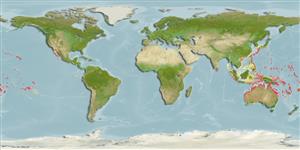
Pacific Ocean: Cocos (Ref. 9399) and Christmas (Ref. 30874) islands in the eastern Indian Ocean to the Hawaiian, Marquesan and Tuamoto islands, north to southern Japan, south to the Great Barrier Reef.
Tamaño / Peso / Edad
Madurez: Lm ? range ? - ? cm
Max length : 18.0 cm TL macho / no sexado; (Ref. 2272)
Descripción breve
Claves de identificación | Morfología | Morfometría
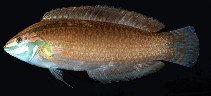
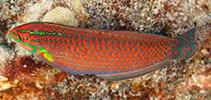
Espinas dorsales (total) : 9; Radios blandos dorsales (total) : 12; Espinas anales: 3; Radios blandos anales: 12. Identified by the red-striped pattern and the two ocelli in the dorsal fin in juveniles and females. Another similar species in Japan that has a spotted tail and lacks the series of white blotches over the back (Ref. 48636). Juveniles closely resemble juveniles of H. biocellatus, but have a brighter metallic sheen to the rows of light green markings along the head and back (Ref. 37816).
Body shape (shape guide): fusiform / normal; Cross section: compressed.
Inhabits lagoon and seaward reefs, coral-rich areas with sand patches (Ref. 9710). Benthopelagic (Ref. 58302). Feeds primarily on small benthic crustaceans and mollusks (Ref. 3921).
Ciclo vital y comportamiento de apareamiento
Madurez | Reproducción | Puesta | Huevos | Fecundidad | Larva
Distinct pairing during breeding (Ref. 205).
Randall, J.E., G.R. Allen and R.C. Steene, 1990. Fishes of the Great Barrier Reef and Coral Sea. University of Hawaii Press, Honolulu, Hawaii. 506 p. (Ref. 2334)
Situación en la Lista Roja de la UICN (Ref. 130435: Version 2025-2 (Global))
Amenaza para el ser humano
Harmless
Usos humanos
Pesquerías: comercial; Acuario: Comercial
Herramientas
Informes especiales
Descargar XML
Fuentes de Internet
Estimaciones basadas en modelos
Temperatura preferida (Referencia
123201): 24.6 - 29.3, mean 28.2 °C (based on 1488 cells).
Índice de diversidad filogenética (Referencia
82804): PD
50 = 0.5000 [Uniqueness, from 0.5 = low to 2.0 = high].
Bayesian length-weight: a=0.01000 (0.00475 - 0.02106), b=3.09 (2.92 - 3.26), in cm total length, based on LWR estimates for this Genus-body shape (Ref.
93245).
Nivel trófico (Referencia
69278): 3.5 ±0.50 se; based on food items.
Resiliencia (Referencia
120179): Alto, población duplicada en un tiempo mínimo inferior a 15 meses (Preliminary K or Fecundity.).
Vulnerabilidad pesquera (Ref.
59153): Low vulnerability (10 of 100).
🛈
Nutrientes (Ref.
124155): Calcium = 80.3 [48.4, 134.7] mg/100g; Iron = 0.688 [0.394, 1.277] mg/100g; Protein = 18.6 [15.7, 20.8] %; Omega3 = 0.143 [0.091, 0.223] g/100g; Selenium = 20.5 [12.2, 37.6] μg/100g; VitaminA = 139 [44, 512] μg/100g; Zinc = 1.65 [1.14, 2.60] mg/100g (wet weight);