>
Eupercaria/misc (Various families in series Eupercaria) >
Labridae (Wrasses) > Julidinae
Etymology: Halichoeres: Greek, als, alis = salt + Greek, choiros = pig (Ref. 45335).
Environnement : milieu / zone climatique / profondeur / gamme de distribution
Écologie
marin récifal; profondeur 4 - 15 m (Ref. 30874). Tropical
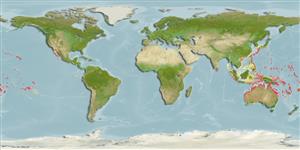
Pacific Ocean: Cocos (Ref. 9399) and Christmas (Ref. 30874) islands in the eastern Indian Ocean to the Hawaiian, Marquesan and Tuamoto islands, north to southern Japan, south to the Great Barrier Reef.
Taille / Poids / Âge
Maturité: Lm ? range ? - ? cm
Max length : 18.0 cm TL mâle / non sexé; (Ref. 2272)
Description synthétique
Clés d'identification | Morphologie | Morphométrie
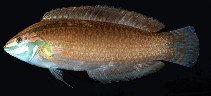
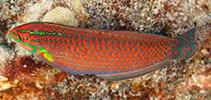
Épines dorsales (Total) : 9; Rayons mous dorsaux (Total) : 12; Épines anales: 3; Rayons mous anaux: 12. Identified by the red-striped pattern and the two ocelli in the dorsal fin in juveniles and females. Another similar species in Japan that has a spotted tail and lacks the series of white blotches over the back (Ref. 48636). Juveniles closely resemble juveniles of H. biocellatus, but have a brighter metallic sheen to the rows of light green markings along the head and back (Ref. 37816).
Body shape (shape guide): fusiform / normal; Cross section: compressed.
Inhabits lagoon and seaward reefs, coral-rich areas with sand patches (Ref. 9710). Benthopelagic (Ref. 58302). Feeds primarily on small benthic crustaceans and mollusks (Ref. 3921).
Cycle de vie et comportement reproducteur
Maturité | Reproduction | Frai | Œufs | Fécondité | Larves
Distinct pairing during breeding (Ref. 205).
Randall, J.E., G.R. Allen and R.C. Steene, 1990. Fishes of the Great Barrier Reef and Coral Sea. University of Hawaii Press, Honolulu, Hawaii. 506 p. (Ref. 2334)
Statut dans la liste rouge de l'IUCN (Ref. 130435: Version 2025-2 (Global))
Menace pour l'homme
Harmless
Utilisations par l'homme
Pêcheries: commercial; Aquarium: Commercial
Outils
Articles particuliers
Télécharger en XML
Sources Internet
Estimations basées sur des modèles
Température préférée (Réf.
123201): 24.6 - 29.3, mean 28.2 °C (based on 1488 cells).
Indice de diversité phylogénétique (Réf.
82804): PD
50 = 0.5000 [Uniqueness, from 0.5 = low to 2.0 = high].
Bayesian length-weight: a=0.01000 (0.00475 - 0.02106), b=3.09 (2.92 - 3.26), in cm total length, based on LWR estimates for this Genus-body shape (Ref.
93245).
Niveau trophique (Réf.
69278): 3.5 ±0.50 se; based on food items.
Résilience (Réf.
120179): Haut, temps minimum de doublement de population inférieur à 15 mois (Preliminary K or Fecundity.).
Vulnérabilité de la pêche (Ref.
59153): Low vulnerability (10 of 100).
🛈
Nutriments (Ref.
124155): Calcium = 80.3 [48.4, 134.7] mg/100g; Iron = 0.688 [0.394, 1.277] mg/100g; Protein = 18.6 [15.7, 20.8] %; Omega3 = 0.143 [0.091, 0.223] g/100g; Selenium = 20.5 [12.2, 37.6] μg/100g; VitaminA = 139 [44, 512] μg/100g; Zinc = 1.65 [1.14, 2.60] mg/100g (wet weight);