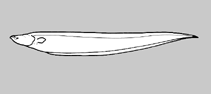
Clasificación / Nombres
Nombres comunes | Sinónimos | Catalog of Fishes(Género, Especie) | ITIS | CoL | WoRMS | Cloffa
>
Gymnotiformes (Knifefishes) >
Gymnotidae (Naked-back knifefishes) > Gymnotinae
Etymology: Gymnotus: Greek, gymnos = naked (Ref. 45335); capanema: Named for its type locality, the municipality of Capanema, Pará, Brazil; noun in apposition (Ref. 89487).
Entorno: milieu / zona climática / rango de profundidad / gama de distribución
Ecología
; agua dulce bentopelágico. Tropical
South America: Brazil.
Tamaño / Peso / Edad
Madurez: Lm ? range ? - ? cm
Max length : 17.9 cm TL macho / no sexado; (Ref. 89487)
Descripción breve
Claves de identificación | Morfología | Morfometría
This species is distinguished from its congeners, except for G. pantanal, in possessing the following characteristics: a unique pigmentation pattern comprising a uniform dark brown background with prominent broad whitish or yellowish posteriorly inflected bands with dark margins, which narrow dorsally in the anterior portion of the body until they completely fade at around the position of the lateral line, never reaching or traversing the dorsal surface of the body; differs from G. pantanal in possessing 2 (vs. 1) adjacent, posteriorly facing, preopercular-mandibular sensory canal pores in the dorsoposterior portion of the preopercle. This species belongs in the G. carapo species group while G. pantanal belongs to the G. pantherinus species group. Gymnotus capanema is further distinguished from G. pantanal in possessing fewer anal-fin rays (180-205 vs. 235-280), has a deeper body (9.6-10.1% LTvs. 8.0-9.5% TL), and fewer pectoral-fin rays (11-15 vs. 16-18).
Gymnotus capanema also differs unambiguously from all other species of the G. carapo species group from the Amazon Basin and north-east Brazil, except G. curupira, G. chaviro and G. varzea, in possessing a short head (8.5-9.3% TL vs. 9.7-14.2% TL); differs from G. curupira in possessing a deeper body (9.6-10.0% TL vs. 7.4-8.6% TL), larger preorbital distance (36.4-49.7% HL vs. 34.3-36.0 HL), fewer pectoral-fin rays (11-15 vs. 16-17), fewer pored lateral-line scales to the first ventral ramus (47-56 vs. 59-62) and the distinct pigmentation reported here; from G. chaviro in possessing fewer pectoral-fin rays (12-15 vs. 18-19) and fewer anal-fin pterygiophore scale rows (5-8 vs. 12-13); from G. varzea in possessing a larger preorbital distance (36.4-49.7% HL vs. 29.7-35.8% HL), fewer anal-fin rays (180-205 vs. 230-310), fewer pectoral-fin rays (11-15 vs. 16-19) and the distinct pigmentation reported in the species description (Ref. 89487).
Facultative air-breathing in the genus (Ref. 126274)
Ciclo vital y comportamiento de apareamiento
Madurez | Reproducción | Puesta | Huevos | Fecundidad | Larva
Milhomem, S.S.R., W.G.R. Crampton, J.C. Pieczarka, G.H. Shetka, D.S. Silva and C.Y. Nagamachi, 2012. Gymnotus capanema, a new species of electric knife fish (Gymnotiformes, Gymnotidae) from eastern Amazonia, with comments on an unusual karyotype. J. Fish Biol. 80(4):802-815. (Ref. 89487)
Situación en la Lista Roja de la UICN (Ref. 130435: Version 2025-2 (Global))
Amenaza para el ser humano
Harmless
Usos humanos
Herramientas
Informes especiales
Descargar XML
Fuentes de Internet
Estimaciones basadas en modelos
Índice de diversidad filogenética (Referencia
82804): PD
50 = 0.5000 [Uniqueness, from 0.5 = low to 2.0 = high].
Bayesian length-weight: a=0.00437 (0.00209 - 0.00911), b=2.98 (2.79 - 3.17), in cm total length, based on LWR estimates for this (Sub)family-body shape (Ref.
93245).
Nivel trófico (Referencia
69278): 3.3 ±0.4 se; based on size and trophs of closest relatives
Resiliencia (Referencia
120179): Alto, población duplicada en un tiempo mínimo inferior a 15 meses (Preliminary K or Fecundity.).
Vulnerabilidad pesquera (Ref.
59153): Low vulnerability (10 of 100).
🛈