Ταξινόμηση / Ονόματα
Κοινά ονόματα | Συνώνυμα | Catalog of Fishes(Γένος, Είδη) | ITIS | CoL | WoRMS | Cloffa
>
Gymnotiformes (Knifefishes) >
Gymnotidae (Naked-back knifefishes) > Gymnotinae
Etymology: Gymnotus: Greek, gymnos = naked (Ref. 45335); capanema: Named for its type locality, the municipality of Capanema, Pará, Brazil; noun in apposition (Ref. 89487).
Περιβάλλον: περιβάλλον / κλιματική ζώνη / εύρος βάθους / εύρος διανομής
Οικολογία
; Γλυκού νερού βενθοπελαγικό. Tropical
South America: Brazil.
Μέγεθος / Βάρος / Ηλικία
Γεννητική Ωρίμανση: Lm ? range ? - ? cm
Max length : 17.9 cm TL αρσενικό/απροσδιόριστο; (Ref. 89487)
Σύντομη περιγραφή
Κλείδες προσδιορισμού | Μορφολογία | Μορφομετρία
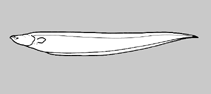
This species is distinguished from its congeners, except for G. pantanal, in possessing the following characteristics: a unique pigmentation pattern comprising a uniform dark brown background with prominent broad whitish or yellowish posteriorly inflected bands with dark margins, which narrow dorsally in the anterior portion of the body until they completely fade at around the position of the lateral line, never reaching or traversing the dorsal surface of the body; differs from G. pantanal in possessing 2 (vs. 1) adjacent, posteriorly facing, preopercular-mandibular sensory canal pores in the dorsoposterior portion of the preopercle. This species belongs in the G. carapo species group while G. pantanal belongs to the G. pantherinus species group. Gymnotus capanema is further distinguished from G. pantanal in possessing fewer anal-fin rays (180-205 vs. 235-280), has a deeper body (9.6-10.1% LTvs. 8.0-9.5% TL), and fewer pectoral-fin rays (11-15 vs. 16-18).
Gymnotus capanema also differs unambiguously from all other species of the G. carapo species group from the Amazon Basin and north-east Brazil, except G. curupira, G. chaviro and G. varzea, in possessing a short head (8.5-9.3% TL vs. 9.7-14.2% TL); differs from G. curupira in possessing a deeper body (9.6-10.0% TL vs. 7.4-8.6% TL), larger preorbital distance (36.4-49.7% HL vs. 34.3-36.0 HL), fewer pectoral-fin rays (11-15 vs. 16-17), fewer pored lateral-line scales to the first ventral ramus (47-56 vs. 59-62) and the distinct pigmentation reported here; from G. chaviro in possessing fewer pectoral-fin rays (12-15 vs. 18-19) and fewer anal-fin pterygiophore scale rows (5-8 vs. 12-13); from G. varzea in possessing a larger preorbital distance (36.4-49.7% HL vs. 29.7-35.8% HL), fewer anal-fin rays (180-205 vs. 230-310), fewer pectoral-fin rays (11-15 vs. 16-19) and the distinct pigmentation reported in the species description (Ref. 89487).
Facultative air-breathing in the genus (Ref. 126274)
Κύκλος ζωής και συμπεριφορά ζευγαρώματος
Γεννητική Ωρίμανση | Αναπαραγωγή | Γεννοβολία | Αβγά | Γονιμότητα | Προνύμφες
Milhomem, S.S.R., W.G.R. Crampton, J.C. Pieczarka, G.H. Shetka, D.S. Silva and C.Y. Nagamachi, 2012. Gymnotus capanema, a new species of electric knife fish (Gymnotiformes, Gymnotidae) from eastern Amazonia, with comments on an unusual karyotype. J. Fish Biol. 80(4):802-815. (Ref. 89487)
Κατάσταση Κόκκινου Καταλόγου IUCN (Ref. 130435: Version 2025-2 (Global))
Απειλή για τον άνθρωπο
Harmless
Ανθρώπινες χρήσεις
Εργαλεία
Ειδικές εκθέσεις
Λήψη XML
Διαδικτυακές πηγές
Εκτιμήσεις βάσει μοντέλων
Δείκτης φυλογενετικής ποικιλότητας (Αναφ.
82804): PD
50 = 0.5000 [Uniqueness, from 0.5 = low to 2.0 = high].
Bayesian length-weight: a=0.00437 (0.00209 - 0.00911), b=2.98 (2.79 - 3.17), in cm total length, based on LWR estimates for this (Sub)family-body shape (Ref.
93245).
Τροφικό Επίπεδο (Αναφ.
69278): 3.3 ±0.4 se; based on size and trophs of closest relatives
Ελαστικότητα (Αναφ.
120179): Υψηλό, ελάχιστος χρόνος για διπλασιασμό πληθυσμού < 15 μήνες (Preliminary K or Fecundity.).
Ευπάθεια στην αλιεία (Ref.
59153): Low vulnerability (10 of 100).
🛈