>
Mulliformes (Goatfishes) >
Mullidae (Goatfishes)
Etymology: Upeneus: Greek, ypene, -es = upper lip (Ref. 45335); itoui: Named for Mr. Masahide Itou who collected almost all Kagoshima specimens of the new species and kindly made them available to the authors. Sakuya-himeji and Oriental Goatfish are herein proposed as the standard Japanese and English names, respectively, for the species (Ref. 88711).
Eponymy: Mr. Masahide Itou is a Japanese ichthyologist based in Kagoshima, Kyushu, Japan. He collected specimens of this goatfish and made them available to the authors. (Ref. 128868), visit book page.
Taxonomic Remarks
FishBase common name changed from Oriental goatfish to Itou's goatfish (Uiblein et al., 2024: Ref. 130857).
Lingkungan: lingkungan / zona iklim / kisaran kedalaman / jangkauan distribusi
Ekologi
laut dasar (demersal); kisaran kedalaman 23 - 27 m (Ref. 88711). Tropical
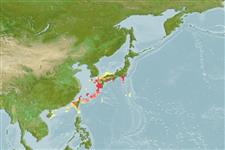
Northwest Pacific: southern Japan.
Ukuran / Berat / umur
Kematangan: Lm ? range ? - ? cm
Max length : 12.3 cm SL jantan/; (Ref. 88711)
deskripsi pendek
Kunci identifiaksi (pengenalan) | Morfologi | Morfometrik
Duri punggung (Keseluruhan (total)) : 7; duri punggung lunak (Keseluruhan (total)) : 9. A species of Upeneus with the following combination of characters: dorsal-fin rays VII + 9, first dorsal-fin spine longest; pectoral-fin rays 13–15 (usually 14); gill rakers 6 or 7 (mode 6) + 16–18 (17) = 22–25 (23); pored lateral-line scales 28–30 (29); no teeth on ectopterygoids; maximum body depth 20.9–24.7% SL (mean 22.7%); maximum head depth 18.0–20.6% SL (19.2%); barbel width 6.0–7.8% HL (7.0%); barbels white; a distinct reddish brown stripe from tip of snout to caudal-fin base through eye in life and fresh specimens; first dorsal fin with 4 irregular white bands in life, 4–6 irregular reddish brown bands (retained as dark bands in preserved specimens) and 4–6 white bands in fresh specimens; upper caudal-fin lobe pale white with 5–7 reddish brown bands (retained as dark bands in preserved specimens) and 5–9 irregular pure white bands in life and fresh specimens; lower caudal-fin lobe reddish with 5–9 short red bands (retained as dark bands in preserved specimens) and 5–9 short white bands or spots along ventral margin in life and fresh specimens (Ref. 88711).
Body shape (shape guide): fusiform / normal.
Yamashita, M., D. Golani and H. Motomura, 2011. A new species of Upeneus (Perciformes: Mullidae) from southern Japan. Zootaxa 3107:47-58. (Ref. 88711)
Status IUCN Red List (Ref. 130435: Version 2025-2 (Global))
ancaman kepada manusia
Harmless
penggunaan manusia
Alat, peralatan
laporan khas
muat turun XML
Sumber internet
Estimasi berdasarkan model
Indeks keanekaragaman filogenetik (Acuan
82804): PD
50 = 0.5000 [Uniqueness, from 0.5 = low to 2.0 = high].
Bayesian length-weight: a=0.00933 (0.00439 - 0.01983), b=3.09 (2.92 - 3.26), in cm total length, based on LWR estimates for this Genus-body shape (Ref.
93245).
Tingkat Trofik (Acuan
69278): 3.4 ±0.4 se; based on size and trophs of closest relatives
Daya lenting (Acuan
120179): Tinggi, Waktu penggandaan populasi minimum kurang dari 15 bulan (Preliminary K or Fecundity.).
Kerentanan Penangkapan Ikan (Ref.
59153): Low vulnerability (10 of 100).
🛈