Classificazione / Nomi
Nomi Comuni | Sinonimi | Catalog of Fishes(Genere, Specie) | ITIS | CoL | WoRMS | Cloffa
>
Siluriformes (Catfishes) >
Amphiliidae (Loach catfishes) > Amphiliinae
Etymology: Amphilius: Greek, amphi = on both sides + Greek, leios = fat; grandis: The species name grandis was chosen, because it was the largest Amphilius species at the time of its description (Ref. 83893).
More on author: Boulenger.
Ambiente: milieu / zona climatica / distribuzione batimetrica / gamma di distribuzione
Ecologia
; acqua dolce demersale. Tropical
Africa: Tana and Ewaso Ngiro River basins in Kenya (Ref. 85045).
Dimensione / Peso / Età
Maturità: Lm ? range ? - ? cm
Max length : 18.1 cm SL maschio/sesso non determinato; (Ref. 85045)
Breve descrizione
Chiavi di identificazione | Morfologia | Morfometria
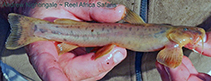
Spine dorsali (totale) : 0; Raggi dorsali molli (totale) : 7 - 8; Spine anali: 0; Raggi anali molli: 9; Vertebre: 37 - 40. Diagnosis: Amphilius grandis is distinguished from A. chalei, A. cryptobullatus, A. krefftii, and A. uranoscopus by the absence of distinct pale patches at the origin and insertion of the dorsal fin; it differs from A. athiensis by the absence of small dark spots on head, body, and fins, vs. head, body, and fins finely spotted, and by having shorter inner mandibular barbels, 20.2-33.6% of head length vs. 33.3-42.0%; it also differs from A. cryptobullatus and A. krefftii by its forked caudal fin vs. emarginate, and from A. krefftii by its more elongate body with 37-40 total vertebrae, vs. usually 36 total vertebrae; it also differs from A. uranoscopus by its body colouration, uniformly brown or brown with large dark spots or blotches, vs. body grey with diffuse black stripe along side; it also differs from A. chalei by having a deeper body, body depth at anus 11.0-14.4% of standard length vs. 8.9-10.8%, and a shorter caudal peduncle, caudal peduncle length 14.6-19.0% of standard length vs. 19.0-21.9%, and it also differs from A. cryptobullatus by having normally developed bilateral bony swimbladder capsules, vs. bilateral bony swimbladder capsules extremely large (Ref. 85045).
Body shape (shape guide): elongated.
Ciclo vitale e comportamento di accoppiamento
Maturità | Riproduzione | Deposizione | Uova | Fecondità | Larve
Thomson, A.W. and L.M. Page, 2010. Taxonomic revision of the Amphilius uranoscopus group (Teleostei: Siluriformes) in Kenya, with the description of a new species from the Athi River. Bull. Flor. Mus. Nat. Hist. 49(2):45-66. (Ref. 85045)
Stato della Lista Rossa IUCN (Ref. 130435: Version 2025-2 (Global))
Minaccia per l'uomo
Harmless
Usi umani
Strumenti
Rapporti speciali
Scarica XML
Fonti Internet
Stime basate su modelli
Indice di diversità filogenetica (Fonte Biblio.
82804): PD
50 = 0.5000 [Uniqueness, from 0.5 = low to 2.0 = high].
Bayesian length-weight: a=0.00490 (0.00203 - 0.01181), b=3.15 (2.94 - 3.36), in cm total length, based on LWR estimates for this (Sub)family-body shape (Ref.
93245).
Livello trofico (Fonte Biblio.
69278): 3.0 ±0.3 se; based on size and trophs of closest relatives
Resilienza (Fonte Biblio.
120179): Medio, tempo minimo di raddoppiamento della popolazione 1.4 - 4.4 anni (Preliminary K or Fecundity.).
Vulnerabilità della pesca (Ref.
59153): Low vulnerability (12 of 100).
🛈