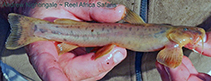
klasifikasi / Nama
Nama-nama umum | Sinonim (persamaan) | Catalog of Fishes(Marga, Jenis) | ITIS | CoL | WoRMS | Cloffa
>
Siluriformes (Catfishes) >
Amphiliidae (Loach catfishes) > Amphiliinae
Etymology: Amphilius: Greek, amphi = on both sides + Greek, leios = fat; grandis: The species name grandis was chosen, because it was the largest Amphilius species at the time of its description (Ref. 83893).
More on author: Boulenger.
Lingkungan: lingkungan / zona iklim / kisaran kedalaman / jangkauan distribusi
Ekologi
; air tawar dasar (demersal). Tropical
Africa: Tana and Ewaso Ngiro River basins in Kenya (Ref. 85045).
Ukuran / Berat / umur
Kematangan: Lm ? range ? - ? cm
Max length : 18.1 cm SL jantan/; (Ref. 85045)
deskripsi pendek
Kunci identifiaksi (pengenalan) | Morfologi | Morfometrik
Duri punggung (Keseluruhan (total)) : 0; duri punggung lunak (Keseluruhan (total)) : 7 - 8; Duri dubur: 0; Sirip dubur lunak: 9; vertebrata, bertulang belakang: 37 - 40. Diagnosis: Amphilius grandis is distinguished from A. chalei, A. cryptobullatus, A. krefftii, and A. uranoscopus by the absence of distinct pale patches at the origin and insertion of the dorsal fin; it differs from A. athiensis by the absence of small dark spots on head, body, and fins, vs. head, body, and fins finely spotted, and by having shorter inner mandibular barbels, 20.2-33.6% of head length vs. 33.3-42.0%; it also differs from A. cryptobullatus and A. krefftii by its forked caudal fin vs. emarginate, and from A. krefftii by its more elongate body with 37-40 total vertebrae, vs. usually 36 total vertebrae; it also differs from A. uranoscopus by its body colouration, uniformly brown or brown with large dark spots or blotches, vs. body grey with diffuse black stripe along side; it also differs from A. chalei by having a deeper body, body depth at anus 11.0-14.4% of standard length vs. 8.9-10.8%, and a shorter caudal peduncle, caudal peduncle length 14.6-19.0% of standard length vs. 19.0-21.9%, and it also differs from A. cryptobullatus by having normally developed bilateral bony swimbladder capsules, vs. bilateral bony swimbladder capsules extremely large (Ref. 85045).
Body shape (shape guide): elongated.
Siklus hidup dan perilaku kawin
Kematangan | Reproduksi, perkembang biakan | Pemijahan | telur-telur | Fekunditas | Larva
Thomson, A.W. and L.M. Page, 2010. Taxonomic revision of the Amphilius uranoscopus group (Teleostei: Siluriformes) in Kenya, with the description of a new species from the Athi River. Bull. Flor. Mus. Nat. Hist. 49(2):45-66. (Ref. 85045)
Status IUCN Red List (Ref. 130435: Version 2025-2 (Global))
ancaman kepada manusia
Harmless
penggunaan manusia
Alat, peralatan
laporan khas
muat turun XML
Sumber internet
Estimasi berdasarkan model
Indeks keanekaragaman filogenetik (Acuan
82804): PD
50 = 0.5000 [Uniqueness, from 0.5 = low to 2.0 = high].
Bayesian length-weight: a=0.00490 (0.00203 - 0.01181), b=3.15 (2.94 - 3.36), in cm total length, based on LWR estimates for this (Sub)family-body shape (Ref.
93245).
Tingkat Trofik (Acuan
69278): 3.0 ±0.3 se; based on size and trophs of closest relatives
Daya lenting (Acuan
120179): sedang, Waktu penggandaan populasi minimum 1.4 - 4.4 tahun (Preliminary K or Fecundity.).
Kerentanan Penangkapan Ikan (Ref.
59153): Low vulnerability (12 of 100).
🛈