Ταξινόμηση / Ονόματα
Κοινά ονόματα | Συνώνυμα | Catalog of Fishes(Γένος, Είδη) | ITIS | CoL | WoRMS | Cloffa
>
Siluriformes (Catfishes) >
Loricariidae (Armored catfishes) > Hypostominae
Etymology: Baryancistrus: Greek, barys = heavy + Greek, agkistron = hook (Ref. 45335); chrysolomus: Derived from the Greek 'chryso', meaning orange or yellow and 'loma', meaning border, in allusion to the colored band at the border of the dorsal and caudal fins. A noun in apposition.
Περιβάλλον: περιβάλλον / κλιματική ζώνη / εύρος βάθους / εύρος διανομής
Οικολογία
; Γλυκού νερού βενθικό(ς). Tropical
South America: Rio Xingu drainage in Brazil.
Μέγεθος / Βάρος / Ηλικία
Γεννητική Ωρίμανση: Lm ? range ? - ? cm
Max length : 29.6 cm TL αρσενικό/απροσδιόριστο; (Ref. 111518); μεγ. δημοσιευμένο βάρος: 410.00 g (Ref. 111518)
Σύντομη περιγραφή
Κλείδες προσδιορισμού | Μορφολογία | Μορφομετρία
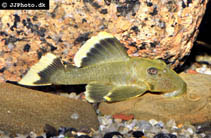
Ραχιαίες άκανθες (συνολικά) : 2; Μαλακές ραχιαίες ακτίνες (συνολικά) : 7; Μαλακές εδρικές ακτίνες: 5. Distinguished from its congeners by having a broad orange to yellow band along the entire distal border of dorsal and caudal fins. Can be diagnosed from other species of Baryancistrus by the combination of the following characters: absence of clear dots on the body; naked abdomen; mandibullary teeth around 70; and dark body with very faint, almost indistinguishable light marks. Both young of Baryancistrus xanthellus and Baryancistrus chrysolomus possess wide light bands on dorsal and caudal fins, but these bands are only retained in adults of Baryancistrus chrysolomus. Both species differ in body coloration, Baryancistrus xanthellus is spotted while Baryancistrus chrysolomus is almost plain (Ref. 87296).
Body shape (shape guide): elongated.
Adults occur under large flat rocks settled directly on the river bottom, in places with considerable amounts of fine sediments. Young individuals inhabit marginal areas of the rapids, near the river banks, usually just one or two individuals. They occupy under rocks in places with slow to moderate flowing waters, usually with sediment accumulation over the rocks and river bottom. Based on two specimens, this species feeds mainly on diatoms and occasionally on invertebrate larvae associated with fine sediments and sand grains (Ref. 87296).
Κύκλος ζωής και συμπεριφορά ζευγαρώματος
Γεννητική Ωρίμανση | Αναπαραγωγή | Γεννοβολία | Αβγά | Γονιμότητα | Προνύμφες
Rapp Py-Daniel, L.H., J. Zuanon and R. Ribeiro de Oliveira, 2011. Two new ornamental loricariid catfishes of Baryancistrus from rio Xingu drainage (Siluriformes: Hypostominae). Neotrop. Ichthyol. 9(2):241-252. (Ref. 87296)
Κατάσταση Κόκκινου Καταλόγου IUCN (Ref. 130435: Version 2025-2 (Global))
Απειλή για τον άνθρωπο
Harmless
Ανθρώπινες χρήσεις
Εργαλεία
Ειδικές εκθέσεις
Λήψη XML
Διαδικτυακές πηγές
Εκτιμήσεις βάσει μοντέλων
Δείκτης φυλογενετικής ποικιλότητας (Αναφ.
82804): PD
50 = 0.5039 [Uniqueness, from 0.5 = low to 2.0 = high].
Bayesian length-weight: a=0.01549 (0.00854 - 0.02810), b=3.00 (2.85 - 3.15), in cm total length, based on LWR estimates for this species & (Sub)family-body (Ref.
93245).
Ελαστικότητα (Αναφ.
120179): Μεσαίο(α), ελάχιστος χρόνος για διπλασιασμό πληθυσμού 1,4 - 4,4 έτη (Preliminary K or Fecundity.).
Ευπάθεια στην αλιεία (Ref.
59153): Low vulnerability (20 of 100).
🛈