>
Siluriformes (Catfishes) >
Loricariidae (Armored catfishes) > Hypostominae
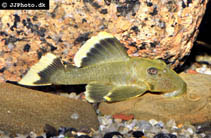
Etymology: Baryancistrus: Greek, barys = heavy + Greek, agkistron = hook (Ref. 45335); chrysolomus: Derived from the Greek 'chryso', meaning orange or yellow and 'loma', meaning border, in allusion to the colored band at the border of the dorsal and caudal fins. A noun in apposition.
Milieu: milieu / Klimaatzone / Diepte / verspreidingsgebied
Ecologie
; zoet water demersaal. Tropical
South America: Rio Xingu drainage in Brazil.
Grootte / Gewicht / Leeftijd
Maturiteit: Lm ? range ? - ? cm
Max length : 29.6 cm TL mannelijk / geslacht onbekend; (Ref. 111518); max. gepubliceerd gewicht: 410.00 g (Ref. 111518)
Korte beschrijving
Determinatiesleutels | Morfologie | Morfometrie
Dorsale stekels (totaal) : 2; Dorsale zachte stralen (totaal) : 7; Anale zachte stralen: 5. Distinguished from its congeners by having a broad orange to yellow band along the entire distal border of dorsal and caudal fins. Can be diagnosed from other species of Baryancistrus by the combination of the following characters: absence of clear dots on the body; naked abdomen; mandibullary teeth around 70; and dark body with very faint, almost indistinguishable light marks. Both young of Baryancistrus xanthellus and Baryancistrus chrysolomus possess wide light bands on dorsal and caudal fins, but these bands are only retained in adults of Baryancistrus chrysolomus. Both species differ in body coloration, Baryancistrus xanthellus is spotted while Baryancistrus chrysolomus is almost plain (Ref. 87296).
Body shape (shape guide): elongated.
Adults occur under large flat rocks settled directly on the river bottom, in places with considerable amounts of fine sediments. Young individuals inhabit marginal areas of the rapids, near the river banks, usually just one or two individuals. They occupy under rocks in places with slow to moderate flowing waters, usually with sediment accumulation over the rocks and river bottom. Based on two specimens, this species feeds mainly on diatoms and occasionally on invertebrate larvae associated with fine sediments and sand grains (Ref. 87296).
Levenscyclus en paargedrag
Maturiteit | Voortplanting | Paaien | Eieren | Fecunditeit | Larven
Rapp Py-Daniel, L.H., J. Zuanon and R. Ribeiro de Oliveira, 2011. Two new ornamental loricariid catfishes of Baryancistrus from rio Xingu drainage (Siluriformes: Hypostominae). Neotrop. Ichthyol. 9(2):241-252. (Ref. 87296)
Status op de Rode Lijst van het IUCN (Ref. 130435: Version 2025-2 (Global))
Gevaar voor de mens
Harmless
Gebruik door de mens
Tools
Speciale rapporten
Download XML
Internetbronnen
Schattingen op basis van modellen
Fylogenetische diversiteitsindex (Ref.
82804): PD
50 = 0.5039 [Uniqueness, from 0.5 = low to 2.0 = high].
Bayesian length-weight: a=0.01549 (0.00854 - 0.02810), b=3.00 (2.85 - 3.15), in cm total length, based on LWR estimates for this species & (Sub)family-body (Ref.
93245).
Weerstandsvermogen (Ref.
120179): Gemiddeld, minimale populatieverdubbelingstijd 1,4-4,4 jaar (Preliminary K or Fecundity.).
Kwetsbaarheid van de visserij (Ref.
59153): Low vulnerability (20 of 100).
🛈