>
Characiformes (Characins) >
Serrasalmidae (Piranhas and pacus) > Serrasalminae
Etymology: Serrasalmus: Latin, serran, serranus, saw and a fish of genus Serranus + Latin, salmo = salmon (Ref. 45335); odyssei: Name applied to the locally known piranha 'suave' and refers to the taxonomic confusion with this species at the beginning of the fieldwork during the present study.
Môi trường: môi trường / vùng khí hậu / Mức độ sâu / phạm vi phân phối
Sinh thái học
; nước ngọt tầng nổi. Tropical
South America: Bolivia.
Bộ gần gũi / Khối lượng (Trọng lượng) / Tuổi
Chín muồi sinh dục: Lm ? range ? - ? cm
Max length : 16.7 cm SL con đực/không giới tính; (Ref. 85594)
Mô tả ngắn gọn
Khóa để định loại | Hình thái học | Sinh trắc học
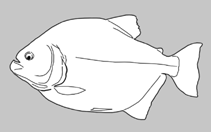
Các vây lưng mềm (tổng cộng) : 13 - 15; Tia mềm vây hậu môn: 28 - 33. This species is distinguished from its congener in the Upper Amazon by the following set of characters: short supraoccipital spine 0.13-0.17% of SL (vs. typical range between 0.17-0.22% of SL in Serrasalmus but sometimes reaching 0.15 and 0.16 in S. hollandi and S. altispinnis); shallow body 0.45-0.57% of SL (vs. typical body height 0.50-0.62% in Serrasalmus); short dorsal fin, between 0.18-0.20% of SL and 13-15 branched rays (vs. 0.19-0.24% of SL in Serrasalmus); short anal fin, typical 0.32-0.37% of SL with 28-33 branched rays, but overlapping sometimes with other Serrasalmus); adipose fin located on the very posterior part of the body and distant from the dorsal fin end, typically R15 ranging between 0.19-0.22% of SL, but overlapping with other Serrasalmus with R15 ranging between 0.17-0.21% of SL); low number of scales between the lateral line and the dorsal fin, 23.5-29.5 (vs. 28.5-36.5 in other Serrasalmus); an intermediate number of prepelvic serrae 20-24 (Ref. 85594).
Body shape (shape guide): short and / or deep; Cross section: compressed.
This species is reported from the clear- to black-water rivers of the Upper Madeira where it seems to be scarce in white waters. Inhabits the shallow part of the river near the shores especially where dead woods accumulate and scarce in the running part of rivers. Apparently common in syntopy with young S. rhombeus individuals of equal size (Ref. 85594).
Vòng đời và hành vi giao phối
Chín muồi sinh dục | Sự tái sinh sản | Đẻ trứng | Các trứng | Sự sinh sản | Ấu trùng
Hubert, N. and J.F. Renno, 2010. Evolution of the neotropical ichthyofauna - molecular and evolutionary perspectives about the origin of the fish communities in the Amazon. VDM Publishing House. (Ref. 85594)
Tình trạng Sách đỏ IUCN (Ref. 130435: Version 2025-2 (Global))
Mối đe dọa đối với con người
Harmless
Sử dụng của con người
Các công cụ
Báo cáo đặc biệt
Tải xuống XML
Các nguồn internet
Ước tính dựa trên mô hình
Chỉ số đa dạng phát sinh loài (Tài liệu tham khảo
82804): PD
50 = 0.5000 [Uniqueness, from 0.5 = low to 2.0 = high].
Bayesian length-weight: a=0.01380 (0.00641 - 0.02973), b=3.16 (2.99 - 3.33), in cm total length, based on LWR estimates for this Genus-body shape (Ref.
93245).
Mức dinh dưỡng (Tài liệu tham khảo
69278): 3.5 ±0.6 se; based on size and trophs of closest relatives
Thích nghi nhanh (Tài liệu tham khảo
120179): Chiêù cao, thời gian nhân đôi của chủng quần tối thiểu là dưới 15 tháng (Preliminary K or Fecundity.).
Sự dễ bị tổn thương của nghề đánh cá (Ref.
59153): Low vulnerability (10 of 100).
🛈