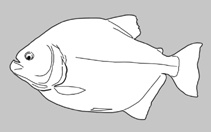
Clasificación / Nombres
Nombres comunes | Sinónimos | Catalog of Fishes(Género, Especie) | ITIS | CoL | WoRMS | Cloffa
>
Characiformes (Characins) >
Serrasalmidae (Piranhas and pacus) > Serrasalminae
Etymology: Serrasalmus: Latin, serran, serranus, saw and a fish of genus Serranus + Latin, salmo = salmon (Ref. 45335); odyssei: Name applied to the locally known piranha 'suave' and refers to the taxonomic confusion with this species at the beginning of the fieldwork during the present study.
Entorno: milieu / zona climática / rango de profundidad / gama de distribución
Ecología
; agua dulce pelágico. Tropical
South America: Bolivia.
Tamaño / Peso / Edad
Madurez: Lm ? range ? - ? cm
Max length : 16.7 cm SL macho / no sexado; (Ref. 85594)
Descripción breve
Claves de identificación | Morfología | Morfometría
Radios blandos dorsales (total) : 13 - 15; Radios blandos anales: 28 - 33. This species is distinguished from its congener in the Upper Amazon by the following set of characters: short supraoccipital spine 0.13-0.17% of SL (vs. typical range between 0.17-0.22% of SL in Serrasalmus but sometimes reaching 0.15 and 0.16 in S. hollandi and S. altispinnis); shallow body 0.45-0.57% of SL (vs. typical body height 0.50-0.62% in Serrasalmus); short dorsal fin, between 0.18-0.20% of SL and 13-15 branched rays (vs. 0.19-0.24% of SL in Serrasalmus); short anal fin, typical 0.32-0.37% of SL with 28-33 branched rays, but overlapping sometimes with other Serrasalmus); adipose fin located on the very posterior part of the body and distant from the dorsal fin end, typically R15 ranging between 0.19-0.22% of SL, but overlapping with other Serrasalmus with R15 ranging between 0.17-0.21% of SL); low number of scales between the lateral line and the dorsal fin, 23.5-29.5 (vs. 28.5-36.5 in other Serrasalmus); an intermediate number of prepelvic serrae 20-24 (Ref. 85594).
Body shape (shape guide): short and / or deep; Cross section: compressed.
This species is reported from the clear- to black-water rivers of the Upper Madeira where it seems to be scarce in white waters. Inhabits the shallow part of the river near the shores especially where dead woods accumulate and scarce in the running part of rivers. Apparently common in syntopy with young S. rhombeus individuals of equal size (Ref. 85594).
Ciclo vital y comportamiento de apareamiento
Madurez | Reproducción | Puesta | Huevos | Fecundidad | Larva
Hubert, N. and J.F. Renno, 2010. Evolution of the neotropical ichthyofauna - molecular and evolutionary perspectives about the origin of the fish communities in the Amazon. VDM Publishing House. (Ref. 85594)
Situación en la Lista Roja de la UICN (Ref. 130435: Version 2025-2 (Global))
Amenaza para el ser humano
Harmless
Usos humanos
Herramientas
Informes especiales
Descargar XML
Fuentes de Internet
Estimaciones basadas en modelos
Índice de diversidad filogenética (Referencia
82804): PD
50 = 0.5000 [Uniqueness, from 0.5 = low to 2.0 = high].
Bayesian length-weight: a=0.01380 (0.00641 - 0.02973), b=3.16 (2.99 - 3.33), in cm total length, based on LWR estimates for this Genus-body shape (Ref.
93245).
Nivel trófico (Referencia
69278): 3.5 ±0.6 se; based on size and trophs of closest relatives
Resiliencia (Referencia
120179): Alto, población duplicada en un tiempo mínimo inferior a 15 meses (Preliminary K or Fecundity.).
Vulnerabilidad pesquera (Ref.
59153): Low vulnerability (10 of 100).
🛈