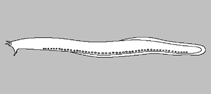
Μυξίνοι (hagfishes) >
Myxiniformes (Hagfishes) >
Myxinidae (Hagfishes) > Eptatretinae
Etymology: Eptatretus: hepta (Gr.), seven; tretos (Gr.), perforated (i.e., with holes), referring to seven gill apertures on what would later be described as Homea banksii (=E. cirrhatus) [range within genus is 6-14 pairs of gill apertures] (See ETYFish); astrolabium: -ium, Latin adjectival suffix: Astrolabe Bay (Papua New Guinea), only known locality, which was named in 1827 by explorer Jules Sébastien César Dumont d’Urville after his ship Astrolabe (See ETYFish).
Περιβάλλον: περιβάλλον / κλιματική ζώνη / εύρος βάθους / εύρος διανομής
Οικολογία
Θαλασσινό(ά) βαθύβιο(ς); εύρος βάθους ? - 500 m (Ref. 85154). Deep-water
Western Pacific: Papua New Guinea.
Μέγεθος / Βάρος / Ηλικία
Γεννητική Ωρίμανση: Lm ? range ? - ? cm
Max length : 40.0 cm TL (female)
Σύντομη περιγραφή
Κλείδες προσδιορισμού | Μορφολογία | Μορφομετρία
This species differs from all its congeners except five Pacific species (Eptatretus carlhubbsi, Eptatretus cirrhatus, Eptatretus goliath, Eptatretus laurahubbsae, Eptatretus strahani) and two Atlantic Ocean species (Eptatretus caribbeaus, Eptatretus menezesi) by having 7 pairs of gill pouches and three-cusp multicusps on the anterior and posterior rows of cusps. It further differs from these congeners by having the following characters: 10 posterior unicusps (vs. 11-13 in E. carlhubbsi, 7-9 in E. cirrhatus, 11-16 in E. laurahubbsae); 52 total cusps (vs. 54-58 in E. caribbeaus, 61-71 in E. carlhubbsi, 61-68 in E. laurahubbsae); 18-19 prebranchial pores (vs. 13-15 in E. caribbeaus, 12-17 in E. carlhubbsi, 14-15 in E. goliath, 14-17 in E. laurahubbsae, 13-17 in E. menezesi, 13-16 in E. strahani); 5 branchial pores (vs. 6-7 or 6-8 for remaining seven-gilled species); 48-49 trunk pores (vs. 60-70 in E. carlhubbsi, 57-58 in E. goliath, 60-67 in E. laurahubbsae); 83-84 total pores (vs. 93-110 in E. carlhubbsi, 92 in E. goliath, 97-105 in E. laurahubbsae, 86-94 in E. menezesi). In addition, these congeners, except E. caribbeaus, have two bilaterally symmetrical nasal-sinus papillae in the dorsal surface of the nasal sinus, while it is absent in E. astrolabium (Ref. 85154).
Body shape (shape guide): eel-like.
The observation re the 'silty mud bottom’ were the specimen was taken, was inferred from sediment in traps retrieved. The female holotype with several small, rounded eggs, ca. 2 mm diameter; all eggs in the mesentery, which is attached to the body wall (Ref. 85154). Iteroparous (Ref. 94918).
Κύκλος ζωής και συμπεριφορά ζευγαρώματος
Γεννητική Ωρίμανση | Αναπαραγωγή | Γεννοβολία | Αβγά | Γονιμότητα | Προνύμφες
Iteroparous (Ref. 94918).
Fernholm, B. and M.M. Mincarone, 2010. A new species of hagfish (Myxinidae: Eptatretus) from Papua New Guinea. J. Fish Biol. 77(4):998-1005. (Ref. 85154)
Κατάσταση Κόκκινου Καταλόγου IUCN (Ref. 130435: Version 2025-2 (Global))
Απειλή για τον άνθρωπο
Harmless
Ανθρώπινες χρήσεις
αλιεία: χωρίς ενδιαφέρον
Εργαλεία
Ειδικές εκθέσεις
Λήψη XML
Διαδικτυακές πηγές
Εκτιμήσεις βάσει μοντέλων
Δείκτης φυλογενετικής ποικιλότητας (Αναφ.
82804): PD
50 = 0.5000 [Uniqueness, from 0.5 = low to 2.0 = high].
Bayesian length-weight: a=0.00204 (0.00094 - 0.00444), b=2.92 (2.72 - 3.12), in cm total length, based on LWR estimates for this (Sub)family-body shape (Ref.
93245).
Τροφικό Επίπεδο (Αναφ.
69278): 4.1 ±0.7 se; based on size and trophs of closest relatives
Ελαστικότητα (Αναφ.
120179): Μεσαίο(α), ελάχιστος χρόνος για διπλασιασμό πληθυσμού 1,4 - 4,4 έτη (Preliminary K or Fecundity.).
Ευπάθεια στην αλιεία (Ref.
59153): Low to moderate vulnerability (30 of 100).
🛈