Klassifizierung / Names
Namen | Synonyme | Catalog of Fishes(Gattung, Arten) | ITIS | CoL | WoRMS | Cloffa
Myxini (Kieferlose) (hagfishes) >
Myxiniformes (Hagfishes) >
Myxinidae (Hagfishes) > Eptatretinae
Etymology: Eptatretus: hepta (Gr.), seven; tretos (Gr.), perforated (i.e., with holes), referring to seven gill apertures on what would later be described as Homea banksii (=E. cirrhatus) [range within genus is 6-14 pairs of gill apertures] (See ETYFish); astrolabium: -ium, Latin adjectival suffix: Astrolabe Bay (Papua New Guinea), only known locality, which was named in 1827 by explorer Jules Sébastien César Dumont d’Urville after his ship Astrolabe (See ETYFish).
Umwelt: Milieu / Klimazone / Tiefenbereich / Verbreitungsgebiet
Ökologie
seewasser bathydemersal; tiefenbereich ? - 500 m (Ref. 85154). Deep-water
Western Pacific: Papua New Guinea.
Größe / Gewicht / Alter
Geschlechtsreife: Lm ? range ? - ? cm
Max length : 40.0 cm TL (female)
Kurzbeschreibung
Bestimmungsschlüssel | Morphologie | Morphometrie
This species differs from all its congeners except five Pacific species (Eptatretus carlhubbsi, Eptatretus cirrhatus, Eptatretus goliath, Eptatretus laurahubbsae, Eptatretus strahani) and two Atlantic Ocean species (Eptatretus caribbeaus, Eptatretus menezesi) by having 7 pairs of gill pouches and three-cusp multicusps on the anterior and posterior rows of cusps. It further differs from these congeners by having the following characters: 10 posterior unicusps (vs. 11-13 in E. carlhubbsi, 7-9 in E. cirrhatus, 11-16 in E. laurahubbsae); 52 total cusps (vs. 54-58 in E. caribbeaus, 61-71 in E. carlhubbsi, 61-68 in E. laurahubbsae); 18-19 prebranchial pores (vs. 13-15 in E. caribbeaus, 12-17 in E. carlhubbsi, 14-15 in E. goliath, 14-17 in E. laurahubbsae, 13-17 in E. menezesi, 13-16 in E. strahani); 5 branchial pores (vs. 6-7 or 6-8 for remaining seven-gilled species); 48-49 trunk pores (vs. 60-70 in E. carlhubbsi, 57-58 in E. goliath, 60-67 in E. laurahubbsae); 83-84 total pores (vs. 93-110 in E. carlhubbsi, 92 in E. goliath, 97-105 in E. laurahubbsae, 86-94 in E. menezesi). In addition, these congeners, except E. caribbeaus, have two bilaterally symmetrical nasal-sinus papillae in the dorsal surface of the nasal sinus, while it is absent in E. astrolabium (Ref. 85154).
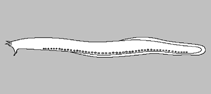
Body shape (shape guide): eel-like.
The observation re the 'silty mud bottom’ were the specimen was taken, was inferred from sediment in traps retrieved. The female holotype with several small, rounded eggs, ca. 2 mm diameter; all eggs in the mesentery, which is attached to the body wall (Ref. 85154). Iteroparous (Ref. 94918).
Lebenszyklus und Paarungsverhalten
Geschlechtsreife | Fortpflanzung | Ablaichen | Eier | Fruchtbarkeit | Larven
Iteroparous (Ref. 94918).
Fernholm, B. and M.M. Mincarone, 2010. A new species of hagfish (Myxinidae: Eptatretus) from Papua New Guinea. J. Fish Biol. 77(4):998-1005. (Ref. 85154)
IUCN Rote Liste Status (Ref. 130435: Version 2025-2 (Global))
Bedrohung für Menschen
Harmless
Nutzung durch Menschen
Fischereien: nicht kommerziell
Tools
Zusatzinformationen
Download XML
Internet Quellen
Schätzungen auf der Grundlage von Modellen
Phylogenetischer Diversitätsindex (Ref.
82804): PD
50 = 0.5000 [Uniqueness, from 0.5 = low to 2.0 = high].
Bayesian length-weight: a=0.00204 (0.00094 - 0.00444), b=2.92 (2.72 - 3.12), in cm total length, based on LWR estimates for this (Sub)family-body shape (Ref.
93245).
Trophische Ebene (Ref.
69278): 4.1 ±0.7 se; based on size and trophs of closest relatives
Widerstandsfähigkeit (Ref.
120179): mittel, Verdopplung der Population dauert 1,4 - 4,4 Jahre. (Preliminary K or Fecundity.).
Anfälligkeit der Fischerei (Ref.
59153): Low to moderate vulnerability (30 of 100).
🛈