Ταξινόμηση / Ονόματα
Κοινά ονόματα | Συνώνυμα | Catalog of Fishes(Γένος, Είδη) | ITIS | CoL | WoRMS | Cloffa
>
Synbranchiformes (Spiny eels) >
Mastacembelidae (Spiny eels)
Etymology: Mastacembelus: Greek, mastax, -agos = bite + Greek, emballo = to throw oneself (Ref. 45335); reygeli: Named for Alain Reygel, artist at the MRAC in Tervuren in appreciation for his numerous beautiful drawings of African fishes.
Eponymy: Alain Marie Robert Godelieve Reygel (d: 1956) is a Belgian artist and scientific illustrator in the Department of Biology at Tervuren (MRAC) (1979–present). [...] (Ref. 128868), visit book page.
Περιβάλλον: περιβάλλον / κλιματική ζώνη / εύρος βάθους / εύρος διανομής
Οικολογία
; Γλυκού νερού βενθοπελαγικό; εύρος βάθους 0 - 10 m (Ref. 82667). Tropical
Africa: endemic to Lake Tanganyika, from Kalemie (Democratic Republic of Congo) to Kigoma (Tanzania) (Ref. 82667).
Μέγεθος / Βάρος / Ηλικία
Γεννητική Ωρίμανση: Lm ? range ? - ? cm
Max length : 25.4 cm SL αρσενικό/απροσδιόριστο; (Ref. 82667)
Σύντομη περιγραφή
Κλείδες προσδιορισμού | Μορφολογία | Μορφομετρία
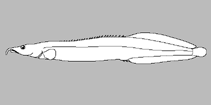
Ραχιαίες άκανθες (συνολικά) : 34 - 38; Μαλακές ραχιαίες ακτίνες (συνολικά) : 54 - 70; Εδρικές άκανθες: 3; Μαλακές εδρικές ακτίνες: 56 - 71; Σπόνδυλοι: 78 - 83. Distinguished from its congeners in Lake Tanganyika by the following characters: short post-anal length 36.6-44.8% SL ( vs. 50.6-60.5 % SL in Mastacembelus ophidium and Mastacembelus polli); brown background color without or with only a limited and scattered dark brown reticulate pattern ( vs. yellow background color with a series of large, saddleshaped, dark brown spots on the dorso-lateral surface of head, body and tail region in Mastacembelus ellipsifer, Mastacembelus plagiostomus and Mastacembelus zebratus); higher number of dorsal spines 34-38 (vs. <30 in Mastacembelus platysoma, Mastacembelus cunningtoni and Mastacembelus moorii and similarly from Mastacembelus micropectus with 26-35 dorsal spines). Additional characters useful to separate from Mastacembelus micropectus include: pectoral-fin length 14.4-25.9% HL (vs. 4.8-22.8% HL); post-anal length 37.5-43.1% SL (vs. 43.9-49.0% HL); brown background color without or with only a limited and scattered dark brown reticulate pattern (vs. a unique color pattern characterized by a light or dark brown background color mostly with numerous tiny yellowish-white spots). Differs from Mastacembelus tanganicae by its lower number of dorsal spines 34-38 (vs. 38-43). In addition, Mastacembelus tanganicae has a unique colour pattern characterized by a
uniform light brown to yellowish background colour with dark brown to black spots on the head, body and tail region forming short zigzag lines on the tail region. This species can also be distinguished by color pattern from Mastacembelus flavidus, which has a uniform light brown to yellowish overall background colour with numerous small, dark brown spots mainly situated on the head, body (above the lateral line) and dorsal fin (Ref. 82667).
Body shape (shape guide): eel-like; Cross section: oval.
Found among rocks at depths from 0 to 10 m (Ref. 82667).
Κύκλος ζωής και συμπεριφορά ζευγαρώματος
Γεννητική Ωρίμανση | Αναπαραγωγή | Γεννοβολία | Αβγά | Γονιμότητα | Προνύμφες
Vreven, E.J. and J. Snoeks, 2009. A new mastacembelid species from Lake Tanganyika: a case complex evolutionary history. J. Fish Biol. 75(5):1018-1047. (Ref. 82667)
Κατάσταση Κόκκινου Καταλόγου IUCN (Ref. 130435: Version 2025-2 (Global))
Απειλή για τον άνθρωπο
Harmless
Ανθρώπινες χρήσεις
Εργαλεία
Ειδικές εκθέσεις
Λήψη XML
Διαδικτυακές πηγές
Εκτιμήσεις βάσει μοντέλων
Δείκτης φυλογενετικής ποικιλότητας (Αναφ.
82804): PD
50 = 0.5000 [Uniqueness, from 0.5 = low to 2.0 = high].
Bayesian length-weight: a=0.00269 (0.00129 - 0.00562), b=2.94 (2.76 - 3.12), in cm total length, based on LWR estimates for this (Sub)family-body shape (Ref.
93245).
Τροφικό Επίπεδο (Αναφ.
69278): 3.8 ±0.6 se; based on size and trophs of closest relatives
Ελαστικότητα (Αναφ.
120179): Υψηλό, ελάχιστος χρόνος για διπλασιασμό πληθυσμού < 15 μήνες (Preliminary K or Fecundity.).
Ευπάθεια στην αλιεία (Ref.
59153): Low vulnerability (21 of 100).
🛈