Classification / Noms
Noms communs | Synonymes | Catalog of Fishes(Genre, Espèce) | ITIS | CoL | WoRMS | Cloffa
>
Synbranchiformes (Spiny eels) >
Mastacembelidae (Spiny eels)
Etymology: Mastacembelus: Greek, mastax, -agos = bite + Greek, emballo = to throw oneself (Ref. 45335); reygeli: Named for Alain Reygel, artist at the MRAC in Tervuren in appreciation for his numerous beautiful drawings of African fishes.
Eponymy: Alain Marie Robert Godelieve Reygel (d: 1956) is a Belgian artist and scientific illustrator in the Department of Biology at Tervuren (MRAC) (1979–present). [...] (Ref. 128868), visit book page.
Environnement : milieu / zone climatique / profondeur / gamme de distribution
Écologie
; eau douce benthopélagique; profondeur 0 - 10 m (Ref. 82667). Tropical
Africa: endemic to Lake Tanganyika, from Kalemie (Democratic Republic of Congo) to Kigoma (Tanzania) (Ref. 82667).
Taille / Poids / Âge
Maturité: Lm ? range ? - ? cm
Max length : 25.4 cm SL mâle / non sexé; (Ref. 82667)
Description synthétique
Clés d'identification | Morphologie | Morphométrie
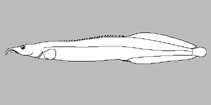
Épines dorsales (Total) : 34 - 38; Rayons mous dorsaux (Total) : 54 - 70; Épines anales: 3; Rayons mous anaux: 56 - 71; Vertèbres: 78 - 83. Distinguished from its congeners in Lake Tanganyika by the following characters: short post-anal length 36.6-44.8% SL ( vs. 50.6-60.5 % SL in Mastacembelus ophidium and Mastacembelus polli); brown background color without or with only a limited and scattered dark brown reticulate pattern ( vs. yellow background color with a series of large, saddleshaped, dark brown spots on the dorso-lateral surface of head, body and tail region in Mastacembelus ellipsifer, Mastacembelus plagiostomus and Mastacembelus zebratus); higher number of dorsal spines 34-38 (vs. <30 in Mastacembelus platysoma, Mastacembelus cunningtoni and Mastacembelus moorii and similarly from Mastacembelus micropectus with 26-35 dorsal spines). Additional characters useful to separate from Mastacembelus micropectus include: pectoral-fin length 14.4-25.9% HL (vs. 4.8-22.8% HL); post-anal length 37.5-43.1% SL (vs. 43.9-49.0% HL); brown background color without or with only a limited and scattered dark brown reticulate pattern (vs. a unique color pattern characterized by a light or dark brown background color mostly with numerous tiny yellowish-white spots). Differs from Mastacembelus tanganicae by its lower number of dorsal spines 34-38 (vs. 38-43). In addition, Mastacembelus tanganicae has a unique colour pattern characterized by a
uniform light brown to yellowish background colour with dark brown to black spots on the head, body and tail region forming short zigzag lines on the tail region. This species can also be distinguished by color pattern from Mastacembelus flavidus, which has a uniform light brown to yellowish overall background colour with numerous small, dark brown spots mainly situated on the head, body (above the lateral line) and dorsal fin (Ref. 82667).
Body shape (shape guide): eel-like; Cross section: oval.
Found among rocks at depths from 0 to 10 m (Ref. 82667).
Cycle de vie et comportement reproducteur
Maturité | Reproduction | Frai | Œufs | Fécondité | Larves
Vreven, E.J. and J. Snoeks, 2009. A new mastacembelid species from Lake Tanganyika: a case complex evolutionary history. J. Fish Biol. 75(5):1018-1047. (Ref. 82667)
Statut dans la liste rouge de l'IUCN (Ref. 130435: Version 2025-2 (Global))
Menace pour l'homme
Harmless
Utilisations par l'homme
Outils
Articles particuliers
Télécharger en XML
Sources Internet
Estimations basées sur des modèles
Indice de diversité phylogénétique (Réf.
82804): PD
50 = 0.5000 [Uniqueness, from 0.5 = low to 2.0 = high].
Bayesian length-weight: a=0.00269 (0.00129 - 0.00562), b=2.94 (2.76 - 3.12), in cm total length, based on LWR estimates for this (Sub)family-body shape (Ref.
93245).
Niveau trophique (Réf.
69278): 3.8 ±0.6 se; based on size and trophs of closest relatives
Résilience (Réf.
120179): Haut, temps minimum de doublement de population inférieur à 15 mois (Preliminary K or Fecundity.).
Vulnérabilité de la pêche (Ref.
59153): Low vulnerability (21 of 100).
🛈