分類 / 名前
共通名の | 類義語 | Catalog of Fishes(部類, 種) | ITIS | CoL | WoRMS | Cloffa
>
Siluriformes (Catfishes) >
Loricariidae (Armored catfishes) > Hypostominae
Etymology: Hypostomus: Greek, hypo = under + Greek, stoma = mouth (Ref. 45335); kopeyaka: After its common name among the Tuyuka and Tukano indians, kope yaka, or kope ya’ka, meaning “pleco from the holes”, an allusion to the fact that, according to the Indians, the fishes spend most of their time hiding in holes in the river ban.
環境:環境 / 気候帯 / 深さの範囲 / 分布範囲
生態学
; 新鮮な水 底生の. Tropical; 1°N - 0°N, 69°W - 70°W
South America: Brazil and probably Colombia. Hypostomus kopeyaka is known only from the rio Tiquié basin, a tributary of the rio Uaupés, upper rio Negro drainage, Brazil. According to Tuyuka fishermen, the species also occurs at the upper rio Tiquié into Departamento Vaupés in Colombia, but no specimens are available from the latter area (Ref. 83896).
サイズ / 重さ / 年齢
成熟: Lm ? range ? - ? cm
Max length : 22.6 cm SL オス/雌雄の選別がない; (Ref. 83896)
簡単な記述
検索表 | 形態学 | 形態計測学
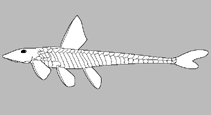
Distinguished from all congeners, except those belonging to the Hypostomus cochliodon group, by having few teeth (10 to 13) bearing a small lateral cusp and acutely angled dentaries. Diagnosed from the remaining members of the Hypostomus cochliodon group, except H. hemicochliodon, H. sculpodon, H. soniae Hollanda, Carvalho & Weber, and H. weberi, by possessing bicuspid teeth with mesial cusp rounded, considerably larger than outer cusp (vs. teeth generally unicuspid, outer cusp, if present, almost imperceptible, mesial cusp large and distinctly spoon-shaped). Hypostomus kopeyaka can be distinguished from H. hemicochliodon, H. sculpodon, H. soniae, and H. weberi by a distinctive color pattern composed of conspicuously horizontally elongated, closely-set black spots on the head and dorsal surfaces of the body (vs. spots absent in H. soniae, spots present but rounded in the remaining species, spots small in H. hemicochliodon and H. sculpodon, and large and widely-set in H. weberi). Additionally, it is differs from all the members of the Hypostomus cochliodon group, except H. weberi, H. ericae Hollanda Carvalho & Weber, H. hemicochliodon, H. paucipunctatus Hollanda Carvalho & Weber, H. sculpodon and H. waiampi Hollanda Carvalho & Weber, by possessing a buccal papilla (Ref. 83896).
Body shape (shape guide): elongated.
Facultative air-breathing in the genus (Ref. 126274); Found in rapids, cataract pools, and slow-flowing portions of the rio Tiquié and some large tributaries (Ref. 83896).
ライフサイクルと交尾行動
成熟 | 繁殖 | 放精 | 卵 | 生産力 | 幼生
Carvalho, P.H., F.C.T. Lima and C.H. Zawadzki, 2010. Two new species of the Hypostomus cochliodon group (Siluriformes: Loricariidae) from the Rio Negro basin in Brazil. Neotrop. Ichthyol. 8(1):39-48. (Ref. 83896)
IUCNのレッドリストの状況は (Ref. 130435: Version 2025-2 (Global))
人間の用途
水産業: 興味がない
用具
特記事項
XMLをダウンロードして下さい
インターネットの情報源
モデルに基づく推定値
系統多様性指数 (参照
82804): PD
50 = 0.5000 [Uniqueness, from 0.5 = low to 2.0 = high].
Bayesian length-weight: a=0.01585 (0.00726 - 0.03460), b=2.95 (2.78 - 3.12), in cm total length, based on LWR estimates for this Genus-body shape (Ref.
93245).
回復力 (参照
120179): 手段, 1.4年~4.4年の倍増期間の最小個体群 (Preliminary K or Fecundity.).
漁業の脆弱性 (Ref.
59153): Low vulnerability (18 of 100).
🛈