Classificazione / Nomi
Nomi Comuni | Sinonimi | Catalog of Fishes(Genere, Specie) | ITIS | CoL | WoRMS | Cloffa
>
Siluriformes (Catfishes) >
Loricariidae (Armored catfishes) > Hypostominae
Etymology: Hypostomus: Greek, hypo = under + Greek, stoma = mouth (Ref. 45335); kopeyaka: After its common name among the Tuyuka and Tukano indians, kope yaka, or kope ya’ka, meaning “pleco from the holes”, an allusion to the fact that, according to the Indians, the fishes spend most of their time hiding in holes in the river ban.
Ambiente: milieu / zona climatica / distribuzione batimetrica / gamma di distribuzione
Ecologia
; acqua dolce demersale. Tropical; 1°N - 0°N, 69°W - 70°W
South America: Brazil and probably Colombia. Hypostomus kopeyaka is known only from the rio Tiquié basin, a tributary of the rio Uaupés, upper rio Negro drainage, Brazil. According to Tuyuka fishermen, the species also occurs at the upper rio Tiquié into Departamento Vaupés in Colombia, but no specimens are available from the latter area (Ref. 83896).
Dimensione / Peso / Età
Maturità: Lm ? range ? - ? cm
Max length : 22.6 cm SL maschio/sesso non determinato; (Ref. 83896)
Breve descrizione
Chiavi di identificazione | Morfologia | Morfometria
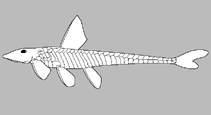
Distinguished from all congeners, except those belonging to the Hypostomus cochliodon group, by having few teeth (10 to 13) bearing a small lateral cusp and acutely angled dentaries. Diagnosed from the remaining members of the Hypostomus cochliodon group, except H. hemicochliodon, H. sculpodon, H. soniae Hollanda, Carvalho & Weber, and H. weberi, by possessing bicuspid teeth with mesial cusp rounded, considerably larger than outer cusp (vs. teeth generally unicuspid, outer cusp, if present, almost imperceptible, mesial cusp large and distinctly spoon-shaped). Hypostomus kopeyaka can be distinguished from H. hemicochliodon, H. sculpodon, H. soniae, and H. weberi by a distinctive color pattern composed of conspicuously horizontally elongated, closely-set black spots on the head and dorsal surfaces of the body (vs. spots absent in H. soniae, spots present but rounded in the remaining species, spots small in H. hemicochliodon and H. sculpodon, and large and widely-set in H. weberi). Additionally, it is differs from all the members of the Hypostomus cochliodon group, except H. weberi, H. ericae Hollanda Carvalho & Weber, H. hemicochliodon, H. paucipunctatus Hollanda Carvalho & Weber, H. sculpodon and H. waiampi Hollanda Carvalho & Weber, by possessing a buccal papilla (Ref. 83896).
Body shape (shape guide): elongated.
Facultative air-breathing in the genus (Ref. 126274); Found in rapids, cataract pools, and slow-flowing portions of the rio Tiquié and some large tributaries (Ref. 83896).
Ciclo vitale e comportamento di accoppiamento
Maturità | Riproduzione | Deposizione | Uova | Fecondità | Larve
Carvalho, P.H., F.C.T. Lima and C.H. Zawadzki, 2010. Two new species of the Hypostomus cochliodon group (Siluriformes: Loricariidae) from the Rio Negro basin in Brazil. Neotrop. Ichthyol. 8(1):39-48. (Ref. 83896)
Stato della Lista Rossa IUCN (Ref. 130435: Version 2025-2 (Global))
Minaccia per l'uomo
Harmless
Usi umani
Pesca: di nessun interesse
Strumenti
Rapporti speciali
Scarica XML
Fonti Internet
Stime basate su modelli
Indice di diversità filogenetica (Fonte Biblio.
82804): PD
50 = 0.5000 [Uniqueness, from 0.5 = low to 2.0 = high].
Bayesian length-weight: a=0.01585 (0.00726 - 0.03460), b=2.95 (2.78 - 3.12), in cm total length, based on LWR estimates for this Genus-body shape (Ref.
93245).
Resilienza (Fonte Biblio.
120179): Medio, tempo minimo di raddoppiamento della popolazione 1.4 - 4.4 anni (Preliminary K or Fecundity.).
Vulnerabilità della pesca (Ref.
59153): Low vulnerability (18 of 100).
🛈