वर्गीकरण / नाम
आम नाम | उपशब्द | Catalog of Fishes(वर्ग, प्रजाति) | ITIS | CoL | WoRMS | Cloffa
>
Tetraodontiformes (Puffers and filefishes) >
Tetraodontidae (Puffers) > Canthigasterinae
Etymology: Canthigaster: Greek, kanthos = the outer or inner corner of the eye, where the lids meet, 1646 + Greek, gaster = stomach (Ref. 45335); cyanospilota: Named for its numerous small bright blue markings.
More on authors: Randall, Williams & Rocha.
पर्यावरण: पर्यावरण / जलवायु क्षेत्र / गहराई सीमा / वितरण सीमा
पारिस्थितिकी
समुद्री ड़िमरसल; गहराई सीमा 10 - 80 m (Ref. 90102). Subtropical
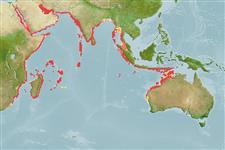
Indian Ocean: Indian Ocean to the Red Sea and Gulf of Aqaba.
आकार / वज़न / आयु
परिपक्व अवधि: Lm ? range ? - ? cm
Max length : 10.4 cm SL पुल्लिंग / अलिंग; (Ref. 83660)
संक्षिप्त वर्णन
पहचान कुंजी | आकृति विज्ञान | मौरफोमैटरिक्स
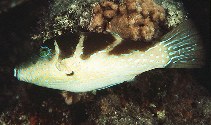
पृष्ठीय सौफट रेज़ (सम्पूर्ण) : 9 - 11; ऐनल सौफट रेज़: 8 - 10; जानवरों की रीड़ का जोड़: 17. This species is distinguished by the following characters: Dorsal rays 9-11 (modally 9 in the Red Sea); anal rays 8-10 (modally 9); pectoral rays 15-17 (rarely 15); gill rakers 9-10; body depth between origins of dorsal and anal fins 3.15-3.6 in SL; head length (HL) 2.2-2.5 in SL; interorbital width 4.25-4.85 in HL: gill opening length 5.4-6.5 in HL; origin of anal fin below of posterior to rear base of dorsal fin, the preanal length 1.25-1.35 in SL; longest dorsal ray 2.6-2.95 in HL; preserved colour pale grey to pale tan with 3 oblique, saddle-like, brown bars on body, not extending below level of upper end of gill opening a broad dark brown band across posterior interorbital and anterior occiput; head and body dark brown dots and short lines, including ones radiating from eye and margins of brown saddles (also within saddles on Red Sea specimens); dark lines on snout behind mouth vertical; below base of pectoral fin, a dark brown spot; a midventral brown line on head and abdomen; fins pale yellowish; live color with dark dots and lines are bright blue, the caudal fin is conspicuously marked with longitudinal blue lines or rows of small blue spots and short lines, snout is often green dorsally (Ref. 83660).
Body shape (shape guide): short and / or deep.
Inhabits seaward reefs on sand-rubble bottoms in 10-80 m. Solitary (Ref. 90102).
जीवन चक्र और संभोग व्यवहार
परिपक्व अवधि | पुनरुत्पत्ति | मछलीऔ का अंडे देना | अंडे | उपजाऊपन | लार्वा
Randall, J.E., J.T. Williams and L.A. Rocha, 2008. The Indo-Pacific tetraodontid fish Canthigaster coronata, a complex of three species. Smithiana, Publ. Aquatic Biodiv. Bull. 9:3-13. (Ref. 83660)
आईयूसीएन रेड लिस्ट स्थिति (Ref. 130435: Version 2025-2 (Global))
मनुष्यों के लिए ख़तरा
Harmless
मानव उपयोग
साधन
विशेष रिपोर्ट
XML डाउनलोड करें
इंटरनेट स्रोत
मॉडल पर आधारित अनुमान
पसंदीदा तापमान (संदर्भ
123201): 24.2 - 29.3, mean 27.7 °C (based on 404 cells).
जातिवृति विविधता सूचकांक (संदर्भ
82804): PD
50 = 0.5000 [Uniqueness, from 0.5 = low to 2.0 = high].
Bayesian length-weight: a=0.03631 (0.01540 - 0.08559), b=2.88 (2.69 - 3.07), in cm total length, based on LWR estimates for this Genus-body shape (Ref.
93245).
ट्रॉफिक स्तर (संदर्भ
69278): 3.1 ±0.3 se; based on size and trophs of closest relatives
लौटाव (संदर्भ
120179): ऊंचा, न्यूनतम जनसंख्या दुगनी समय अवलागत 15 महीने। (Preliminary K or Fecundity.).
मछली पकड़ने की भेद्यता (Ref.
59153): Low vulnerability (10 of 100).
🛈