>
Tetraodontiformes (Puffers and filefishes) >
Tetraodontidae (Puffers) > Canthigasterinae
Etymology: Canthigaster: Greek, kanthos = the outer or inner corner of the eye, where the lids meet, 1646 + Greek, gaster = stomach (Ref. 45335); cyanospilota: Named for its numerous small bright blue markings.
More on authors: Randall, Williams & Rocha.
Lingkungan: lingkungan / zona iklim / kisaran kedalaman / jangkauan distribusi
Ekologi
laut dasar (demersal); kisaran kedalaman 10 - 80 m (Ref. 90102). Subtropical
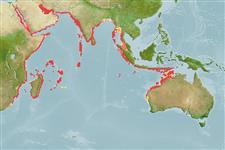
Indian Ocean: Indian Ocean to the Red Sea and Gulf of Aqaba.
Ukuran / Berat / umur
Kematangan: Lm ? range ? - ? cm
Max length : 10.4 cm SL jantan/; (Ref. 83660)
deskripsi pendek
Kunci identifiaksi (pengenalan) | Morfologi | Morfometrik
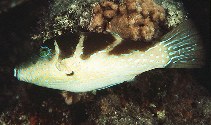
duri punggung lunak (Keseluruhan (total)) : 9 - 11; Sirip dubur lunak: 8 - 10; vertebrata, bertulang belakang: 17. This species is distinguished by the following characters: Dorsal rays 9-11 (modally 9 in the Red Sea); anal rays 8-10 (modally 9); pectoral rays 15-17 (rarely 15); gill rakers 9-10; body depth between origins of dorsal and anal fins 3.15-3.6 in SL; head length (HL) 2.2-2.5 in SL; interorbital width 4.25-4.85 in HL: gill opening length 5.4-6.5 in HL; origin of anal fin below of posterior to rear base of dorsal fin, the preanal length 1.25-1.35 in SL; longest dorsal ray 2.6-2.95 in HL; preserved colour pale grey to pale tan with 3 oblique, saddle-like, brown bars on body, not extending below level of upper end of gill opening a broad dark brown band across posterior interorbital and anterior occiput; head and body dark brown dots and short lines, including ones radiating from eye and margins of brown saddles (also within saddles on Red Sea specimens); dark lines on snout behind mouth vertical; below base of pectoral fin, a dark brown spot; a midventral brown line on head and abdomen; fins pale yellowish; live color with dark dots and lines are bright blue, the caudal fin is conspicuously marked with longitudinal blue lines or rows of small blue spots and short lines, snout is often green dorsally (Ref. 83660).
Body shape (shape guide): short and / or deep.
Inhabits seaward reefs on sand-rubble bottoms in 10-80 m. Solitary (Ref. 90102).
Siklus hidup dan perilaku kawin
Kematangan | Reproduksi, perkembang biakan | Pemijahan | telur-telur | Fekunditas | Larva
Randall, J.E., J.T. Williams and L.A. Rocha, 2008. The Indo-Pacific tetraodontid fish Canthigaster coronata, a complex of three species. Smithiana, Publ. Aquatic Biodiv. Bull. 9:3-13. (Ref. 83660)
Status IUCN Red List (Ref. 130435: Version 2025-2 (Global))
ancaman kepada manusia
Harmless
penggunaan manusia
Alat, peralatan
laporan khas
muat turun XML
Sumber internet
Estimasi berdasarkan model
Suhu yang disukai (Acuan
123201): 24.2 - 29.3, mean 27.7 °C (based on 404 cells).
Indeks keanekaragaman filogenetik (Acuan
82804): PD
50 = 0.5000 [Uniqueness, from 0.5 = low to 2.0 = high].
Bayesian length-weight: a=0.03631 (0.01540 - 0.08559), b=2.88 (2.69 - 3.07), in cm total length, based on LWR estimates for this Genus-body shape (Ref.
93245).
Tingkat Trofik (Acuan
69278): 3.1 ±0.3 se; based on size and trophs of closest relatives
Daya lenting (Acuan
120179): Tinggi, Waktu penggandaan populasi minimum kurang dari 15 bulan (Preliminary K or Fecundity.).
Kerentanan Penangkapan Ikan (Ref.
59153): Low vulnerability (10 of 100).
🛈