分类 / 名称
俗名 | 同种异名 | Catalog of Fishes(属, 种) | ITIS | CoL | WoRMS | Cloffa
Teleostei >
Characiformes (Characins) >
Acestrorhamphidae (American tetras) > Jupiabinae
Etymology: Jupiaba: An indigenous word from Brazil, in the region where Angela (Ichthyologist) was born and discovered several new fishes. (Personal communication from Barry Chernoff, Curator Fishes/Museum of Chicago; citrina: From the Latin citrus, meaning lemon, orange, in allusion to the orange-yellowish coloration of body portions of the species in life.
环境:氛围 / 气候带 / 深度上下限 / 分布范围
生态学
; 淡水 大洋性. ; 8°S - 9°S, 60°W - 61°W
分布
领土 | FAO区域 | 生态系 | 标本纪录 | 分布图 | 简介 | Faunafri
South America: Brazil. Rio Aripuanã, rio Madeira basin, Amazonas and Mato Grosso States (Ref. 83383).
大小 / 重量 / 年龄
成熟度: Lm ? range ? - ? cm
Max length : 6.1 cm SL 雄鱼/尚未辨别雌雄; (Ref. 83383)
简单描述
检索表 | 型态特徵 | 形态测量图
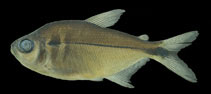
This species is distinguished from its congeners (except J. abramoides, J. anteroides, and J. poranga by its color pattern, with 2 vertically-elongated humeral blotches, the anterior usually with a darker median portion forming an horizontally elongated trace pointed anteriorly, and a well defined dark longitudinal line extending from the second humeral blotch to the caudal peduncle; differs from J. abramoides, J. anteroides, and J. poranga by having an horizontally-elongated blotch on caudal peduncle that extends continuously to the distal tip of the caudal-fin median rays (vs. dark line not forming blotch on caudal peduncle and posterior end of this line isolated from dark blotch over caudal fin rays by a clear area); differs from various congeners (except J. abramoides, J. anteroides, J. apenima, J. asymmetrica, J. poranga, and J. yarina), by having the predorsal median area without a series of scales (vs. with a series of organized scales); differs further from J. poranga and J. yarina by its lower number of perforated scales (47-51 vs. 56-66) and the lower number of scales between dorsal-fin origin and lateral line 10-11 (one specimen with 12) vs. 12-15] and between lateral line and origin of pelvic fin (8-9 vs. 10-13); differs from J. apenima by having lower number of perforated scales (47-51 vs. 55-59); additionally distinguished from part of its congeners (J. acanthogaster, J. atypindi, J. keithi, J. maroniensis, J. meunieri, J. kurua, J. minor, J. pinnata, and J. poekotero) by having teeth with a distinctly larger median cusp and dentary teeth decreasing abruptly in size posteriorly (vs. median teeth cusp similar in size to the remaining cusps and dentary teeth decreasing gradually in size towards posterior portion); differs from the remaining species, J. citrina and further from J. iasy, J. mucronata, J. ocellata, J. paranatinga, J. pirana, J. polylepis, J. potaroensis, and J. zonata by having higher number of perforated scales (47-51 vs. 33-45), and from J. elassonaktis, J. essequibensis, and J. scologaster by having higher number of branched anal-fin rays (24-27 vs. 17-23 (Ref. 83383).
Body shape (shape guide): short and / or deep.
生命周期和交配行为
成熟度 | 繁殖 | 产卵场 | 卵 | 孕卵数 | 仔鱼
Zanata, A.M. and W.M. Ohara, 2009. Jupiaba citrina, a new species from rio Aripuanã, rio Madeira basin, Amazonas and Mato Grosso States, Brazil (Characiformes: Characidae). Neotrop. Ichthyol. 7(4):513-518. (Ref. 83383)
世界自然保护联盟红皮书 (Ref. 130435: Version 2025-2 (Global))
人类利用
工具
特别资料
下载 XML
网络资源
基于模型的估算
系统发育多样性指数 (参考文献
82804): PD
50 = 0.5000 [Uniqueness, from 0.5 = low to 2.0 = high].
Bayesian length-weight: a=0.01047 (0.00465 - 0.02359), b=3.18 (2.99 - 3.37), in cm total length, based on LWR estimates for this Genus-body shape (Ref.
93245).
营养阶层 (参考文献
69278): 2.9 ±0.3 se; based on size and trophs of closest relatives
渔业脆弱性 (Ref.
59153): Low vulnerability (10 of 100).
🛈