Classificazione / Nomi
Nomi Comuni | Sinonimi | Catalog of Fishes(Genere, Specie) | ITIS | CoL | WoRMS | Cloffa
>
Characiformes (Characins) >
Acestrorhamphidae (American tetras) > Jupiabinae
Etymology: Jupiaba: An indigenous word from Brazil, in the region where Angela (Ichthyologist) was born and discovered several new fishes. (Personal communication from Barry Chernoff, Curator Fishes/Museum of Chicago; citrina: From the Latin citrus, meaning lemon, orange, in allusion to the orange-yellowish coloration of body portions of the species in life.
Ambiente: milieu / zona climatica / distribuzione batimetrica / gamma di distribuzione
Ecologia
; acqua dolce pelagico. Tropical; 8°S - 9°S, 60°W - 61°W
South America: Brazil. Rio Aripuanã, rio Madeira basin, Amazonas and Mato Grosso States (Ref. 83383).
Dimensione / Peso / Età
Maturità: Lm ? range ? - ? cm
Max length : 6.1 cm SL maschio/sesso non determinato; (Ref. 83383)
Breve descrizione
Chiavi di identificazione | Morfologia | Morfometria
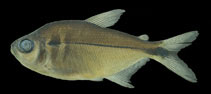
This species is distinguished from its congeners (except J. abramoides, J. anteroides, and J. poranga by its color pattern, with 2 vertically-elongated humeral blotches, the anterior usually with a darker median portion forming an horizontally elongated trace pointed anteriorly, and a well defined dark longitudinal line extending from the second humeral blotch to the caudal peduncle; differs from J. abramoides, J. anteroides, and J. poranga by having an horizontally-elongated blotch on caudal peduncle that extends continuously to the distal tip of the caudal-fin median rays (vs. dark line not forming blotch on caudal peduncle and posterior end of this line isolated from dark blotch over caudal fin rays by a clear area); differs from various congeners (except J. abramoides, J. anteroides, J. apenima, J. asymmetrica, J. poranga, and J. yarina), by having the predorsal median area without a series of scales (vs. with a series of organized scales); differs further from J. poranga and J. yarina by its lower number of perforated scales (47-51 vs. 56-66) and the lower number of scales between dorsal-fin origin and lateral line 10-11 (one specimen with 12) vs. 12-15] and between lateral line and origin of pelvic fin (8-9 vs. 10-13); differs from J. apenima by having lower number of perforated scales (47-51 vs. 55-59); additionally distinguished from part of its congeners (J. acanthogaster, J. atypindi, J. keithi, J. maroniensis, J. meunieri, J. kurua, J. minor, J. pinnata, and J. poekotero) by having teeth with a distinctly larger median cusp and dentary teeth decreasing abruptly in size posteriorly (vs. median teeth cusp similar in size to the remaining cusps and dentary teeth decreasing gradually in size towards posterior portion); differs from the remaining species, J. citrina and further from J. iasy, J. mucronata, J. ocellata, J. paranatinga, J. pirana, J. polylepis, J. potaroensis, and J. zonata by having higher number of perforated scales (47-51 vs. 33-45), and from J. elassonaktis, J. essequibensis, and J. scologaster by having higher number of branched anal-fin rays (24-27 vs. 17-23 (Ref. 83383).
Body shape (shape guide): short and / or deep.
Ciclo vitale e comportamento di accoppiamento
Maturità | Riproduzione | Deposizione | Uova | Fecondità | Larve
Zanata, A.M. and W.M. Ohara, 2009. Jupiaba citrina, a new species from rio Aripuanã, rio Madeira basin, Amazonas and Mato Grosso States, Brazil (Characiformes: Characidae). Neotrop. Ichthyol. 7(4):513-518. (Ref. 83383)
Stato della Lista Rossa IUCN (Ref. 130435: Version 2025-2 (Global))
Minaccia per l'uomo
Harmless
Usi umani
Strumenti
Rapporti speciali
Scarica XML
Fonti Internet
Stime basate su modelli
Indice di diversità filogenetica (Fonte Biblio.
82804): PD
50 = 0.5000 [Uniqueness, from 0.5 = low to 2.0 = high].
Bayesian length-weight: a=0.01047 (0.00465 - 0.02359), b=3.18 (2.99 - 3.37), in cm total length, based on LWR estimates for this Genus-body shape (Ref.
93245).
Livello trofico (Fonte Biblio.
69278): 2.9 ±0.3 se; based on size and trophs of closest relatives
Vulnerabilità della pesca (Ref.
59153): Low vulnerability (10 of 100).
🛈