Elasmobranquios (tiburones y rayas) (sharks and rays) >
Myliobatiformes (Stingrays) >
Mobulidae (Devilrays)
Eponymy: Prince Alfred, Duke of Edinburgh (1844–1900) was a son of Queen Victoria who ruled as Duke of Saxe-Coburg and Gotha (1893) in the Prussian Empire. [...] (Ref. 128868), visit book page.
Entorno: milieu / zona climática / rango de profundidad / gama de distribución
Ecología
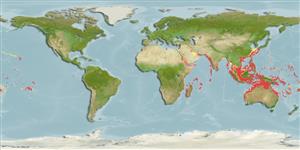
marino; agua dulce bentopelágico; rango de profundidad 0 - 120 m (Ref. 86942). Tropical; 32°N - 34°S, 30°E - 134°W
Indo-Pacific: Red Sea, South Africa, Thailand to Western Australia.; north to Japan (Yaeyama Is.), to Solitary Is., Australia as far east as French Polynesia and the Hawaiian Is. Reported in the Atlantic (Canary and Cape Verde islands) but this species may be restricted more or less to the Indian and Western Pacific only (McEachran, pers.comm. 03/10).
Longitud en la primera madurez / Tamaño / Peso / Edad
Madurez: Lm 371.1, range 324 - 390 cm
Max length : 450 cm WD macho / no sexado; (Ref. ); edad máxima reportada: 31 años (Ref. 97313)
Descripción breve
Claves de identificación | Morfología | Morfometría
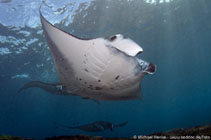
This species is characterized by the following: disc approximately 2.2-2.4 times as broad as it is long, the maximum disc width size approximately 550 cm; slender whip-like tail approximately 123% of disc length if intact; no distinct caudal spine or cartilaginous mass at base of tail; some specimens have small hump at the base of the tail on the dorsal surface, while others have a slight depression and groove on the dorsum of the tail immediately posterior to the posterior margin of the dorsal fin; small, knob-like dermal denticles evenly distributed on both the dorsal and ventral surfaces, with ventral surface having slightly larger denticles; dental ligament with small cusped teeth on the lower jaw measuring roughly 22% of total disc length, approximately 6-8 rows, 142-182 files across entire width of the tooth band; total tooth counts of 900-1500 for entire tooth band; top jaw lacks rows of enlarged denticles (Ref. 82755).
Body shape (shape guide): other.
Adults are commonly sighted inshore, within a few kilometers of land; found around coral and rocky reefs as well as along productive coastlines with consistent upwelling, tropical island groups, atolls and bays (Ref. 82755). Maximum movement recorded is >500,000 m (Ref. 97317). Known aggregations include sites in Hawai'i, Mozambique, Maldives, Ryukyu Island, Yap Island, Indonesia, eastern and western Australia (Ref. 82755). Gestation period is 12-13 months. Major food consists of planktonic organisms and probably small bony fishes (Ref. 114953). Maximum correted to 450 cm WD by Giuseppe Notarbartolo di Sciara (pers. Comm. 01/2025).
Young may tend to follow large objects such as their mother (Ref. 205).
Last, P.R., W.T. White, M.R. de Carvalho, B. Séret, M.F.W. Stehmann and G.J.P. Naylor, 2016. Rays of the world. CSIRO Publishing, Comstock Publishing Associates. i-ix + 1-790. (Ref. 114953)
Situación en la Lista Roja de la UICN (Ref. 130435: Version 2025-2 (Global))
Amenaza para el ser humano
Harmless
Usos humanos
Herramientas
Informes especiales
Descargar XML
Fuentes de Internet
Estimaciones basadas en modelos
Temperatura preferida (Referencia
123201): 24.3 - 29, mean 27.8 °C (based on 1274 cells).
Índice de diversidad filogenética (Referencia
82804): PD
50 = 0.5020 [Uniqueness, from 0.5 = low to 2.0 = high].
Bayesian length-weight: a=0.01000 (0.00244 - 0.04107), b=3.04 (2.81 - 3.27), in cm total length, based on all LWR estimates for this body shape (Ref.
93245).
Nivel trófico (Referencia
69278): 3.5 ±0.5 se; based on size and trophs of closest relatives
Resiliencia (Referencia
120179): Muy bajo, población duplicada en un tiempo mínimo superior a 14 años (tmax>31; tm = 3-8; Fec =1).
Vulnerabilidad pesquera (Ref.
59153): Very high vulnerability (83 of 100).
🛈
Nutrientes (Ref.
124155): Calcium = 5.54 [0.80, 100.50] mg/100g; Iron = 0.474 [0.044, 5.786] mg/100g; Protein = 19.2 [13.9, 24.5] %; Omega3 = 0.0832 [, ] g/100g; Selenium = 90.7 [16.3, 541.7] μg/100g; VitaminA = 6.64 [0.42, 83.54] μg/100g; Zinc = 0.545 [0.030, 6.451] mg/100g (wet weight);