sub class Elasmobranchii (ฉลามและกระเบน) (sharks and rays) >
Squaliformes (Sleeper and dogfish sharks) >
Centrophoridae (Gulper sharks)
Etymology: Centrophorus: centr[um] (L.), prickle or sharp point; phorus, from phoreus (Gr.), bearer or carrier, referring to grooved spines on dorsal fins (See ETYFish); lusitanicus: -icus, belonging to: Lusitania, ancient name of Portugal, type locality (although identity of holotype is in dispute, treated as a junior synonym of C. granulosus by some workers) (See ETYFish).
Taxonomic Remarks
Available evidence suggests that this species refers to the true C. granulosus from off
Portugal and so must be considered a junior synonym of the latter species. The purported syntype BMNH 1867.7.23.2 is not a type specimen and refers to a separate long-finned species (see Ref. 116740 for available evidence).
สิ่งแวดล้อม : สิ่งแวดล้อม / เขตภูมิอากาศ / ระดับความลึก / ระยะการกระจายสินค้า
นิเวศวิทยา
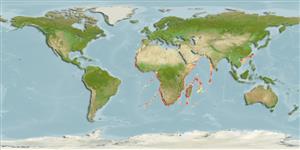
เกี่ยวกับทะเล,น้ำเค็ม สัตว์หน้าดินในเขตน้ำลึก; ระดับความลึก 300 - 1400 m (Ref. 247). Deep-water; 43°N - 38°S, 18°W - 124°E (Ref. 54312)
Eastern Atlantic: Portugal, Senegal, Côte d'Ivoire to Nigeria. Western Indian Ocean: southern Mozambique and possibly Natal, South Africa (Ref. 11228). Western Pacific: China (Ref. 6577) and Taiwan (Ref. 247); occurrence in the Western Central Pacific uncertain but should be watched for (Ref. 31367). Often confused with Centrophorus niaukang and Centrophorus granulosus (Ref. 31367).
ความยาวเมื่อครบกำหนดครั้งแรก / ขนาด / น้ำหนัก / อายุ
วัยเจริญพันธุ์: Lm 116.0, range 88 - 144 cm
Max length : 160 cm TL เพศผู้/กระเทย; (Ref. 5578)
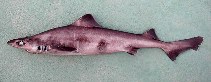
เงี่ยงครีบหลัง (รวม) : 2; เงี่ยงครีบก้น: 0. A large, stout gulper shark with a broad snout, a long, low 1st dorsal fin and a high 2nd dorsal fin; pectoral rear tips moderately long; denticles low, flat and smooth (Ref. 5578). Pearl-grey in color (Ref. 5578).
Body shape (shape guide): elongated.
A large deepwater dogfish of the outer continental shelves and upper slopes (Ref. 247). Feeds on bony fish, small dogfish sharks, squids, and lobsters (Ref. 247). Ovoviviparous (Ref. 50449). Utilized as food fish and as fishmeal (Ref. 247).
Ovoviviparous, embryos feed solely on yolk (Ref. 50449). Number of young 1 to 6 per litter; size at birth 33-36 cm TL (Ref. 247, Ref. 58048). Distinct pairing with embrace (Ref. 205).
Compagno, L.J.V., 1984. FAO Species Catalogue. Vol. 4. Sharks of the world. An annotated and illustrated catalogue of shark species known to date. Part 1 - Hexanchiformes to Lamniformes. FAO Fish. Synop. 125(4/1):1-249. Rome, FAO. (Ref. 247)
สถานะบัญชีแดงของ IUCN (Ref. 130435: Version 2025-2 (Global))
ภัยคุกคามต่อมนุษย์
Harmless
การใช้ของมนุษย์
การประมง: มีการค้าเพียงเล็กน้อย
เครื่องมือ
รายงานพิเศษ
ดาวน์โหลด XML
แหล่งที่มาจากอินเตอร์เน็ต
การประมาณค่าตามแบบจำลอง
อุณหภูมิที่ต้องการ (อ้างอิง
123201): 5.3 - 12, mean 9 °C (based on 147 cells).
ดัชนีความหลากหลายทางวิวัฒนาการ (อ้างอิง
82804): PD
50 = 0.5001 [Uniqueness, from 0.5 = low to 2.0 = high].
Bayesian length-weight: a=0.00251 (0.00120 - 0.00527), b=3.19 (3.01 - 3.37), in cm total length, based on LWR estimates for this (Sub)family-body shape (Ref.
93245).
ระดับชั้นอาหาร (อ้างอิง
69278): 4.4 ±0.63 se; based on food items.
ความสามารถในการกลับคืนสู่ปกติ (อ้างอิง
120179): ต่ำมาก, เวลาต่ำสุดที่จะทำให้ประชากรเพิ่มขึ้นเป็น 2 เท่าใช้เวลามากกว่า 14 ปี (Fec=1).
ความเสี่ยงต่อการตกปลา (Ref.
59153): Very high vulnerability (90 of 100).
🛈
ความเสี่ยงต่อสภาพภูมิอากาศ (Ref.
125649): Moderate to high vulnerability (54 of 100).
🛈
สารอาหาร (Ref.
124155): Calcium = 5.05 [1.00, 27.00] mg/100g; Iron = 0.277 [0.066, 0.918] mg/100g; Protein = 19.9 [17.6, 22.1] %; Omega3 = 0.277 [0.101, 0.883] g/100g; Selenium = 18.6 [5.7, 55.4] μg/100g; VitaminA = 10.8 [2.3, 53.2] μg/100g; Zinc = 0.259 [0.125, 0.499] mg/100g (wet weight);