Elasmobranchii (Haie und Rochen) (sharks and rays) >
Squaliformes (Sleeper and dogfish sharks) >
Centrophoridae (Gulper sharks)
Etymology: Centrophorus: centr[um] (L.), prickle or sharp point; phorus, from phoreus (Gr.), bearer or carrier, referring to grooved spines on dorsal fins (See ETYFish); lusitanicus: -icus, belonging to: Lusitania, ancient name of Portugal, type locality (although identity of holotype is in dispute, treated as a junior synonym of C. granulosus by some workers) (See ETYFish).
Taxonomic Remarks
Available evidence suggests that this species refers to the true C. granulosus from off
Portugal and so must be considered a junior synonym of the latter species. The purported syntype BMNH 1867.7.23.2 is not a type specimen and refers to a separate long-finned species (see Ref. 116740 for available evidence).
Umwelt: Milieu / Klimazone / Tiefenbereich / Verbreitungsgebiet
Ökologie
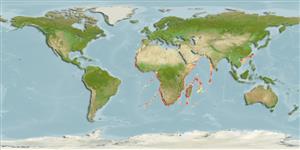
seewasser bathydemersal; tiefenbereich 300 - 1400 m (Ref. 247). Deep-water; 43°N - 38°S, 18°W - 124°E (Ref. 54312)
Eastern Atlantic: Portugal, Senegal, Côte d'Ivoire to Nigeria. Western Indian Ocean: southern Mozambique and possibly Natal, South Africa (Ref. 11228). Western Pacific: China (Ref. 6577) and Taiwan (Ref. 247); occurrence in the Western Central Pacific uncertain but should be watched for (Ref. 31367). Often confused with Centrophorus niaukang and Centrophorus granulosus (Ref. 31367).
Länge bei der ersten Reifung / Größe / Gewicht / Alter
Geschlechtsreife: Lm 116.0, range 88 - 144 cm
Max length : 160 cm TL Männchen/unbestimmt; (Ref. 5578)
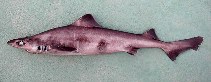
Rückenflossenstacheln (insgesamt) : 2; Afterflossenstacheln: 0. A large, stout gulper shark with a broad snout, a long, low 1st dorsal fin and a high 2nd dorsal fin; pectoral rear tips moderately long; denticles low, flat and smooth (Ref. 5578). Pearl-grey in color (Ref. 5578).
Body shape (shape guide): elongated.
A large deepwater dogfish of the outer continental shelves and upper slopes (Ref. 247). Feeds on bony fish, small dogfish sharks, squids, and lobsters (Ref. 247). Ovoviviparous (Ref. 50449). Utilized as food fish and as fishmeal (Ref. 247).
Ovoviviparous, embryos feed solely on yolk (Ref. 50449). Number of young 1 to 6 per litter; size at birth 33-36 cm TL (Ref. 247, Ref. 58048). Distinct pairing with embrace (Ref. 205).
Compagno, L.J.V., 1984. FAO Species Catalogue. Vol. 4. Sharks of the world. An annotated and illustrated catalogue of shark species known to date. Part 1 - Hexanchiformes to Lamniformes. FAO Fish. Synop. 125(4/1):1-249. Rome, FAO. (Ref. 247)
IUCN Rote Liste Status (Ref. 130435: Version 2025-2 (Global))
Bedrohung für Menschen
Harmless
Nutzung durch Menschen
Fischereien: weniger kommerziell
Tools
Zusatzinformationen
Download XML
Internet Quellen
Schätzungen auf der Grundlage von Modellen
Bevorzugte Temperatur (Ref.
123201): 5.3 - 12, mean 9 °C (based on 147 cells).
Phylogenetischer Diversitätsindex (Ref.
82804): PD
50 = 0.5001 [Uniqueness, from 0.5 = low to 2.0 = high].
Bayesian length-weight: a=0.00251 (0.00120 - 0.00527), b=3.19 (3.01 - 3.37), in cm total length, based on LWR estimates for this (Sub)family-body shape (Ref.
93245).
Trophische Ebene (Ref.
69278): 4.4 ±0.63 se; based on food items.
Widerstandsfähigkeit (Ref.
120179): sehr niedrig, Verdopplung der Population dauert mehr als 14 Jahre. (Fec=1).
Anfälligkeit der Fischerei (Ref.
59153): Very high vulnerability (90 of 100).
🛈
Klimaanfälligkeit (Ref.
125649): Moderate to high vulnerability (54 of 100).
🛈
Nährstoffe (Ref.
124155): Calcium = 5.05 [1.00, 27.00] mg/100g; Iron = 0.277 [0.066, 0.918] mg/100g; Protein = 19.9 [17.6, 22.1] %; Omega3 = 0.277 [0.101, 0.883] g/100g; Selenium = 18.6 [5.7, 55.4] μg/100g; VitaminA = 10.8 [2.3, 53.2] μg/100g; Zinc = 0.259 [0.125, 0.499] mg/100g (wet weight);