>
Perciformes/Uranoscopoidei (Sand dwellers) >
Pinguipedidae (Sandperches)
Etymology: Parapercis: Greek, para = the side of + Greek, perke = perch (Ref. 45335); diagonalis: Name from Latin, referring to the diagonal black line on the cheek.
More on author: Randall.
Ambiente: milieu / zona climatica / distribuzione batimetrica / gamma di distribuzione
Ecologia
marino benthopelagico; distribuzione batimetrica 1 - 25 m (Ref. 90102). Tropical
Western Pacific: Indonesia.
Dimensione / Peso / Età
Maturità: Lm ? range ? - ? cm
Max length : 15.0 cm TL maschio/sesso non determinato; (Ref. 79876); 12.8 cm SL (female)
Breve descrizione
Chiavi di identificazione | Morfologia | Morfometria
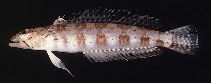
Spine dorsali (totale) : 5; Raggi dorsali molli (totale) : 21; Spine anali: 1; Raggi anali molli: 17; Vertebre: 30. This species is distinguished by the following characters: body's upper third greenish-brown in life with a series of 6 large, quadrangular, blackish spots, progressively shorter posteriorly; the lower 2/3 of it white, faintly blotched with pink and dotted with black, and the lower third with 6 large, quadrangular, dark reddish spots, dotted with black dorsally; head bluish grey with an oblique black line on cheek below eye, ending in a small black spot, followed by 2 broad reddish bands; a large black spot on dorsal fin centered on base of spinous part, and a row of small black spots on the soft portion; base of anal fin with a row of black spots; caudal fin with 2 broad blackish stripes; D V,21; A I,17; pectoral rays 16; 57 lateral line scales; gill rakers 7 + 11; lower jaw projecting, 3 pairs of canine teeth anteriorly in jaws; palatine teeth absent; vomerine teeth in a narrow, chevron-shaped patch of 3-4 rows; ctenoid scales dorsally on opercle, becoming cycloid, progressively smaller, and nonimbricate ventrally on cheek; 4th dorsal spine longest 3.7 in HL; greatest body depth 4.8 in SL; head length (HL) 3.65 in SL; orbit diameter 4.4 in HL; fourth dorsal spine is the longest; caudal fin emarginate on upper half with a narrow protruding posterior upper lobe and rounded on ventral half; pectoral fins 5.75 in SL; pelvic fins just reaching anus, 5.05 in SL (Ref. 79876).
Body shape (shape guide): elongated.
Specimen collected on silty sand substrate, a piece of partially buried plastic tubing was used as a refuge by the fish. It has a well-developed testis, but a small strip of ovarian tissue was also found, indicative of a nearly completed sex change from female to male (Ref. 79876). Solitary (Ref. 90102). Maximum length of 15 cm (TL) of unsexed specimen reported from Ref. 90102.
Ciclo vitale e comportamento di accoppiamento
Maturità | Riproduzione | Deposizione | Uova | Fecondità | Larve
Randall, J.E., 2008. Six new sandperches of the genus Parapercis from the Western Pacific, with description of a neotype for P. maculata (bloch and Schneider). The Raffles Bull. Zool. 19:159-178. (Ref. 79876)
Stato della Lista Rossa IUCN (Ref. 130435: Version 2025-2 (Global))
Minaccia per l'uomo
Harmless
Usi umani
Strumenti
Rapporti speciali
Scarica XML
Fonti Internet
Stime basate su modelli
Indice di diversità filogenetica (Fonte Biblio.
82804): PD
50 = 0.5000 [Uniqueness, from 0.5 = low to 2.0 = high].
Bayesian length-weight: a=0.00692 (0.00314 - 0.01524), b=3.06 (2.88 - 3.24), in cm total length, based on LWR estimates for this Genus-body shape (Ref.
93245).
Livello trofico (Fonte Biblio.
69278): 3.5 ±0.4 se; based on size and trophs of closest relatives
Resilienza (Fonte Biblio.
120179): Alto, tempo minimo di raddoppiamento della popolazione meno di 15 mesi (Preliminary K or Fecundity.).
Vulnerabilità della pesca (Ref.
59153): Low vulnerability (10 of 100).
🛈