>
Perciformes/Uranoscopoidei (Sand dwellers) >
Pinguipedidae (Sandperches)
Etymology: Parapercis: Greek, para = the side of + Greek, perke = perch (Ref. 45335); diagonalis: Name from Latin, referring to the diagonal black line on the cheek.
More on author: Randall.
Environnement : milieu / zone climatique / profondeur / gamme de distribution
Écologie
marin benthopélagique; profondeur 1 - 25 m (Ref. 90102). Tropical
Distribution
Territoires | Zones FAO | Écosystèmes | Occurrences | Carte par point | Introductions | Faunafri
Western Pacific: Indonesia.
Taille / Poids / Âge
Maturité: Lm ? range ? - ? cm
Max length : 15.0 cm TL mâle / non sexé; (Ref. 79876); 12.8 cm SL (female)
Description synthétique
Clés d'identification | Morphologie | Morphométrie
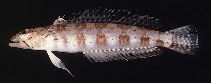
Épines dorsales (Total) : 5; Rayons mous dorsaux (Total) : 21; Épines anales: 1; Rayons mous anaux: 17; Vertèbres: 30. This species is distinguished by the following characters: body's upper third greenish-brown in life with a series of 6 large, quadrangular, blackish spots, progressively shorter posteriorly; the lower 2/3 of it white, faintly blotched with pink and dotted with black, and the lower third with 6 large, quadrangular, dark reddish spots, dotted with black dorsally; head bluish grey with an oblique black line on cheek below eye, ending in a small black spot, followed by 2 broad reddish bands; a large black spot on dorsal fin centered on base of spinous part, and a row of small black spots on the soft portion; base of anal fin with a row of black spots; caudal fin with 2 broad blackish stripes; D V,21; A I,17; pectoral rays 16; 57 lateral line scales; gill rakers 7 + 11; lower jaw projecting, 3 pairs of canine teeth anteriorly in jaws; palatine teeth absent; vomerine teeth in a narrow, chevron-shaped patch of 3-4 rows; ctenoid scales dorsally on opercle, becoming cycloid, progressively smaller, and nonimbricate ventrally on cheek; 4th dorsal spine longest 3.7 in HL; greatest body depth 4.8 in SL; head length (HL) 3.65 in SL; orbit diameter 4.4 in HL; fourth dorsal spine is the longest; caudal fin emarginate on upper half with a narrow protruding posterior upper lobe and rounded on ventral half; pectoral fins 5.75 in SL; pelvic fins just reaching anus, 5.05 in SL (Ref. 79876).
Body shape (shape guide): elongated.
Specimen collected on silty sand substrate, a piece of partially buried plastic tubing was used as a refuge by the fish. It has a well-developed testis, but a small strip of ovarian tissue was also found, indicative of a nearly completed sex change from female to male (Ref. 79876). Solitary (Ref. 90102). Maximum length of 15 cm (TL) of unsexed specimen reported from Ref. 90102.
Cycle de vie et comportement reproducteur
Maturité | Reproduction | Frai | Œufs | Fécondité | Larves
Randall, J.E., 2008. Six new sandperches of the genus Parapercis from the Western Pacific, with description of a neotype for P. maculata (bloch and Schneider). The Raffles Bull. Zool. 19:159-178. (Ref. 79876)
Statut dans la liste rouge de l'IUCN (Ref. 130435: Version 2025-2 (Global))
Menace pour l'homme
Harmless
Utilisations par l'homme
Outils
Articles particuliers
Télécharger en XML
Sources Internet
Estimations basées sur des modèles
Indice de diversité phylogénétique (Réf.
82804): PD
50 = 0.5000 [Uniqueness, from 0.5 = low to 2.0 = high].
Bayesian length-weight: a=0.00692 (0.00314 - 0.01524), b=3.06 (2.88 - 3.24), in cm total length, based on LWR estimates for this Genus-body shape (Ref.
93245).
Niveau trophique (Réf.
69278): 3.5 ±0.4 se; based on size and trophs of closest relatives
Résilience (Réf.
120179): Haut, temps minimum de doublement de population inférieur à 15 mois (Preliminary K or Fecundity.).
Vulnérabilité de la pêche (Ref.
59153): Low vulnerability (10 of 100).
🛈