Environnement : milieu / zone climatique / profondeur / gamme de distribution
Écologie
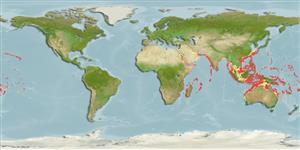
marin récifal; non migrateur; profondeur 40 - 300 m (Ref. 89972), usually 100 - 250 m (Ref. 9710). Tropical; 30°N - 59°S, 29°E - 150°W (Ref. 5222)
Indo-Pacific: islands of the western Indian Ocean to Japan and the central Pacific. Except for a single specimen caught off the coast of Natal, South Africa, Heemstra and Randall 1993 know of no confirmed records from other continental localities of East Africa. Cephalopholis aurantia from east Africa reported by Morgans 1982 (Ref. 6448) is a misidentification of Cephalopholis nigripinnis.
Taille / Poids / Âge
Maturité: Lm ? range ? - ? cm
Max length : 60.0 cm TL mâle / non sexé; (Ref. 4319); common length : 30.0 cm TL mâle / non sexé; (Ref. 5450)
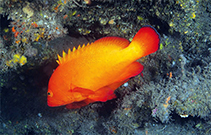
Épines dorsales (Total) : 9; Rayons mous dorsaux (Total) : 14 - 16; Épines anales: 3; Rayons mous anaux: 8 - 9. Pale orange-red to orange-yellow or golden with red or yellow dots on head, anterodorsally on body, and on base of dorsal fin. Posterior margin of caudal fin with a pale blue edge and black submarginal line; posterior parts of dorsal and anal fins often with a narrow pale blue edge; further characterized by having ctenoid scales on body including most of abdomen; greatest body depth 2.5-3.0 in SL; rounded caudal fin; pelvic fins usually reaching anus, 1.6-2.0 in head length (Ref. 90102); head length 2.4-2.6 times in SL; interorbital area flat; rounded preopercle, finely serrate, lower edge fleshy; subopercle and interopercle serrate; scaly maxilla, reaching to or beyond vertical at rear edge of eye (Ref. 89707).
Body shape (shape guide): fusiform / normal; Cross section: oval.
Rare species (Ref. 4319). Found on steep seaward reefs (Ref. 9710). Museum specimens are lacking. Usually at depths of 100-250 m, but can occur in shallower water (Ref. 89707). Feeds mainly on crabs (Ref. 89972). Solitary (Ref 90102).
Cycle de vie et comportement reproducteur
Maturité | Reproduction | Frai | Œufs | Fécondité | Larves
Heemstra, P.C. and J.E. Randall, 1993. FAO Species Catalogue. Vol. 16. Groupers of the world (family Serranidae, subfamily Epinephelinae). An annotated and illustrated catalogue of the grouper, rockcod, hind, coral grouper and lyretail species known to date. Rome: FAO. FAO Fish. Synop. 125(16):382 p. (Ref. 5222)
Statut dans la liste rouge de l'IUCN (Ref. 130435: Version 2025-2 (Global))
Menace pour l'homme
Harmless
Utilisations par l'homme
Pêcheries: intérêt commercial mineur
Outils
Articles particuliers
Télécharger en XML
Sources Internet
Estimations basées sur des modèles
Température préférée (Réf.
123201): 13.1 - 25, mean 19.1 °C (based on 438 cells).
Indice de diversité phylogénétique (Réf.
82804): PD
50 = 0.5000 [Uniqueness, from 0.5 = low to 2.0 = high].
Bayesian length-weight: a=0.01230 (0.00576 - 0.02626), b=3.04 (2.87 - 3.21), in cm total length, based on LWR estimates for this Genus-body shape (Ref.
93245).
Niveau trophique (Réf.
69278): 4.0 ±0.65 se; based on food items.
Résilience (Réf.
120179): Milieu, temps minimum de doublement de population : 1,4 à 4,4 années (Preliminary K or Fecundity.).
Vulnérabilité de la pêche (Ref.
59153): Moderate vulnerability (44 of 100).
🛈
Nutriments (Ref.
124155): Calcium = 32.8 [17.5, 54.9] mg/100g; Iron = 0.437 [0.239, 0.833] mg/100g; Protein = 18.6 [16.7, 20.2] %; Omega3 = 0.178 [0.109, 0.295] g/100g; Selenium = 57.9 [29.9, 100.8] μg/100g; VitaminA = 82.8 [30.0, 262.9] μg/100g; Zinc = 0.748 [0.512, 1.205] mg/100g (wet weight);