Lingkungan: lingkungan / zona iklim / kisaran kedalaman / jangkauan distribusi
Ekologi
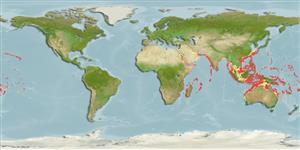
laut berasosiasi dengan karang; nir-ruaya; kisaran kedalaman 40 - 300 m (Ref. 89972), usually 100 - 250 m (Ref. 9710). Tropical; 30°N - 59°S, 29°E - 150°W (Ref. 5222)
Indo-Pacific: islands of the western Indian Ocean to Japan and the central Pacific. Except for a single specimen caught off the coast of Natal, South Africa, Heemstra and Randall 1993 know of no confirmed records from other continental localities of East Africa. Cephalopholis aurantia from east Africa reported by Morgans 1982 (Ref. 6448) is a misidentification of Cephalopholis nigripinnis.
Ukuran / Berat / umur
Kematangan: Lm ? range ? - ? cm
Max length : 60.0 cm TL jantan/; (Ref. 4319); common length : 30.0 cm TL jantan/; (Ref. 5450)
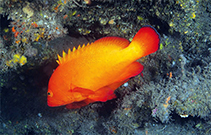
Duri punggung (Keseluruhan (total)) : 9; duri punggung lunak (Keseluruhan (total)) : 14 - 16; Duri dubur: 3; Sirip dubur lunak: 8 - 9. Pale orange-red to orange-yellow or golden with red or yellow dots on head, anterodorsally on body, and on base of dorsal fin. Posterior margin of caudal fin with a pale blue edge and black submarginal line; posterior parts of dorsal and anal fins often with a narrow pale blue edge; further characterized by having ctenoid scales on body including most of abdomen; greatest body depth 2.5-3.0 in SL; rounded caudal fin; pelvic fins usually reaching anus, 1.6-2.0 in head length (Ref. 90102); head length 2.4-2.6 times in SL; interorbital area flat; rounded preopercle, finely serrate, lower edge fleshy; subopercle and interopercle serrate; scaly maxilla, reaching to or beyond vertical at rear edge of eye (Ref. 89707).
Body shape (shape guide): fusiform / normal; Cross section: oval.
Rare species (Ref. 4319). Found on steep seaward reefs (Ref. 9710). Museum specimens are lacking. Usually at depths of 100-250 m, but can occur in shallower water (Ref. 89707). Feeds mainly on crabs (Ref. 89972). Solitary (Ref 90102).
Siklus hidup dan perilaku kawin
Kematangan | Reproduksi, perkembang biakan | Pemijahan | telur-telur | Fekunditas | Larva
Heemstra, P.C. and J.E. Randall, 1993. FAO Species Catalogue. Vol. 16. Groupers of the world (family Serranidae, subfamily Epinephelinae). An annotated and illustrated catalogue of the grouper, rockcod, hind, coral grouper and lyretail species known to date. Rome: FAO. FAO Fish. Synop. 125(16):382 p. (Ref. 5222)
Status IUCN Red List (Ref. 130435: Version 2025-2 (Global))
ancaman kepada manusia
Harmless
penggunaan manusia
Perikanan: nilai komersial kecil
Alat, peralatan
laporan khas
muat turun XML
Sumber internet
Estimasi berdasarkan model
Suhu yang disukai (Acuan
123201): 13.1 - 25, mean 19.1 °C (based on 438 cells).
Indeks keanekaragaman filogenetik (Acuan
82804): PD
50 = 0.5000 [Uniqueness, from 0.5 = low to 2.0 = high].
Bayesian length-weight: a=0.01230 (0.00576 - 0.02626), b=3.04 (2.87 - 3.21), in cm total length, based on LWR estimates for this Genus-body shape (Ref.
93245).
Tingkat Trofik (Acuan
69278): 4.0 ±0.65 se; based on food items.
Daya lenting (Acuan
120179): sedang, Waktu penggandaan populasi minimum 1.4 - 4.4 tahun (Preliminary K or Fecundity.).
Kerentanan Penangkapan Ikan (Ref.
59153): Moderate vulnerability (44 of 100).
🛈
Nutrisi (Ref.
124155): Calcium = 32.8 [17.5, 54.9] mg/100g; Iron = 0.437 [0.239, 0.833] mg/100g; Protein = 18.6 [16.7, 20.2] %; Omega3 = 0.178 [0.109, 0.295] g/100g; Selenium = 57.9 [29.9, 100.8] μg/100g; VitaminA = 82.8 [30.0, 262.9] μg/100g; Zinc = 0.748 [0.512, 1.205] mg/100g (wet weight);