Taxonomic Remarks
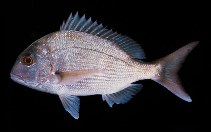
There has been much confusion in the past literature between the names Chrysophrys aurata/us, Pagrus aurata/us and Sparus aurata/us, that were used for two different species: Pagrus auratus (Forster, 1801) from the West Pacific on one side, Sparus aurata Linnaeus, 1758 from the Northeast and Central Atlantic on the other side, Check the geographic origin of specimens when these names are used in the literature.
Umwelt: Milieu / Klimazone / Tiefenbereich / Verbreitungsgebiet
Ökologie
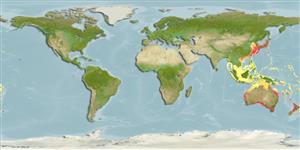
seewasser; brackwasser riff-verbunden; ozeanodrom (Ref. 51243); tiefenbereich 0 - 200 m (Ref. 28569). Subtropical; 44°N - 47°S, 90°E - 175°W
Indo-Pacific: widely occurring off New Zealand, Australia, Philippines, Indonesia, China, Taiwan, and Japan. Populations in the northern and southern hemispheres are independent and isolated but were similar enough to be declared one and the same species (Ref. 28569, 28591).
Länge bei der ersten Reifung / Größe / Gewicht / Alter
Geschlechtsreife: Lm 26.2, range 20 - 28 cm
Max length : 130 cm TL Männchen/unbestimmt; (Ref. 2334); common length : 40.0 cm TL Männchen/unbestimmt; (Ref. 3243); max. veröff. Gewicht: 20.0 kg (Ref. 28591); max. veröff. Alter: 54 Jahre (Ref. 92924)
Inhabit rocky reefs (Ref. 9702). Also occur in estuaries (Ref. 9563). Juveniles mainly inhabit inlets, bays and other shallow, sheltered marine waters, often over mud and seagrass (Ref. 6390). Small fish measuring less than 30 cm TL are common inshore around reef areas often in groups of around 30 individuals. Larger fish are shy and are less frequently seen (Ref. 26966). Adults often live near reefs, but are also found over mud and sand substrates (Ref. 6390). They are relatively sedentary. However, tagging studies have shown them capable of substantial migrations (Ref. 28591). Crustaceans (crabs, shrimps, etc) form the basis of the diet, but marine worms, starfish, sea urchins, shellfish and fish are also important (Ref. 28591). Not commercially cultured at present but considered as a prime aquaculture candidate (Ref. 28590). Maximum estimated age for SW Pacific is 54 years with validated longevity on the order of 40 years based on minimum age from bomb radiocarbon dating (Ref. 92924; Allen Andrews, pers.comm. 01/13). It is parasitised by the monogenean Anoplodiscus cirrusspiralis on the fins and body surface (Ref. 124057).
Mature adults form large schools in preferred spawning areas (Ref. 6390). They are serial spawners (Ref. 6390). Spawning generally occurs in waters less than 50 m deep (Ref. 6390). They generally only spawn when water temp is equal to 18°C (Ref. 6390).
There have been no investigations of sex reversals in Australian snapper populations. However, in New Zealand, some juvenile snapper change sex from female to male but all such changes are completed by the onset of maturity (Ref. 28040).
Paulin, C.D., 1990. Pagrus auratus, a new combination for the species known as "snapper" in Australasian waters (Pisces: Sparidae). N.Z. J. Mar. Freshwat. Res. 24(2):259-265. (Ref. 28569)
IUCN Rote Liste Status (Ref. 130435: Version 2025-2 (Global))
Bedrohung für Menschen
Harmless
Nutzung durch Menschen
Fischereien: kommerziell; Aquakultur: experimental; Sportfisch: ja
Tools
Zusatzinformationen
Download XML
Internet Quellen
Schätzungen auf der Grundlage von Modellen
Bevorzugte Temperatur (Ref.
123201): 14 - 25.2, mean 17.4 °C (based on 293 cells).
Phylogenetischer Diversitätsindex (Ref.
82804): PD
50 = 0.5156 [Uniqueness, from 0.5 = low to 2.0 = high].
Bayesian length-weight: a=0.02188 (0.01256 - 0.03811), b=2.97 (2.82 - 3.12), in cm total length, based on LWR estimates for this species & (Sub)family-body (Ref.
93245).
Trophische Ebene (Ref.
69278): 3.6 ±0.2 se; based on diet studies.
Widerstandsfähigkeit (Ref.
120179): niedrig, Verdopplung der Population dauert 4,5 - 14 Jahre. (tmax=11).
Prior r = 0.34, 95% CL = 0.23 - 0.52, Based on 3 full stock assessments.
Anfälligkeit der Fischerei (Ref.
59153): High to very high vulnerability (69 of 100).
🛈
Klimaanfälligkeit (Ref.
125649): High vulnerability (60 of 100).
🛈
Nährstoffe (Ref.
124155): Calcium = 12 [5, 25] mg/100g; Iron = 0.581 [0.194, 1.769] mg/100g; Protein = 20.8 [19.1, 22.7] %; Omega3 = 0.139 [0.067, 0.297] g/100g; Selenium = 24.5 [10.4, 61.8] μg/100g; VitaminA = 18.4 [3.6, 93.0] μg/100g; Zinc = 0.569 [0.277, 1.225] mg/100g (wet weight);