分類 / 名稱
俗名 | 同種異名 | Catalog of Fishes(屬, 種) | ITIS | CoL | WoRMS | Cloffa
Teleostei >
Eupercaria/misc (Various families in series Eupercaria)
鱸形目 (Various families in series Eupercaria) >
Sparidae (Porgies)
鯛科 (Porgies)
Etymology: Pagrus: Greek, pagros = a fish, Dentex, sp. (Ref. 45335).
More on author: Forster.
Taxonomic Remarks
There has been much confusion in the past literature between the names Chrysophrys aurata/us, Pagrus aurata/us and Sparus aurata/us, that were used for two different species: Pagrus auratus (Forster, 1801) from the West Pacific on one side, Sparus aurata Linnaeus, 1758 from the Northeast and Central Atlantic on the other side, Check the geographic origin of specimens when these names are used in the literature.
環境: 環境 / 氣候帶 / 深度上下限 / 配送範圍
生態學
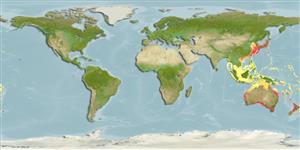
海洋; 半鹹淡水 礁區魚類; 海洋洄游的 (Ref. 51243); 深度上下限 0 - 200 m (Ref. 28569). 亞熱帶的; 44°N - 47°S, 90°E - 175°W
Indo-Pacific: widely occurring off New Zealand, Australia, Philippines, Indonesia, China, Taiwan, and Japan. Populations in the northern and southern hemispheres are independent and isolated but were similar enough to be declared one and the same species (Ref. 28569, 28591).
印度-太平洋: 廣泛地出現外海的紐西蘭,澳洲,菲律賓,印尼,中國,台灣與日本。 在北部與南半球的族群是獨立而孤立的但是夠相似來被宣佈一與相同的種.(參考文獻 28569,28591)
初熟時的長度 / 大小 / 重量 / 年齡
成熟度: Lm 26.2, range 20 - 28 cm
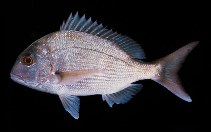
Max length : 130 cm TL 雄魚/尚未辨別雌雄; (Ref. 2334); common length : 40.0 cm TL 雄魚/尚未辨別雌雄; (Ref. 3243); 最大體重: 20.0 kg (Ref. 28591); 最大年齡: 54 年 (Ref. 92924)
Inhabit rocky reefs (Ref. 9702). Also occur in estuaries (Ref. 9563). Juveniles mainly inhabit inlets, bays and other shallow, sheltered marine waters, often over mud and seagrass (Ref. 6390). Small fish measuring less than 30 cm TL are common inshore around reef areas often in groups of around 30 individuals. Larger fish are shy and are less frequently seen (Ref. 26966). Adults often live near reefs, but are also found over mud and sand substrates (Ref. 6390). They are relatively sedentary. However, tagging studies have shown them capable of substantial migrations (Ref. 28591). Crustaceans (crabs, shrimps, etc) form the basis of the diet, but marine worms, starfish, sea urchins, shellfish and fish are also important (Ref. 28591). Not commercially cultured at present but considered as a prime aquaculture candidate (Ref. 28590). Maximum estimated age for SW Pacific is 54 years with validated longevity on the order of 40 years based on minimum age from bomb radiocarbon dating (Ref. 92924; Allen Andrews, pers.comm. 01/13). It is parasitised by the monogenean Anoplodiscus cirrusspiralis on the fins and body surface (Ref. 124057).
棲息於岩礁。 (參考文獻 9702) 也出現在河口。 (參考文獻 9563) 稚魚主要地居住於小水灣, 海灣與其他的水淺又掩蔽的海洋, 時常在泥與海草上面.(參考文獻 6390) 測量少於 30 公分TL 的小魚是礁區的周圍大約 30個個體是常形成魚群的普遍沿海地區。 較大的魚是害羞而且時常更不被見到。 (參考文獻 26966) 成魚時常生活在礁的附近, 但是也被發現在泥地與沙地底部上面.(參考文獻 6390) 他們是相當定棲的。 然而,附以籤條研究已經給他們看能夠實質上的迴游。 (參考文獻 28591) 甲殼動物 (螃蟹,蝦 , 等等) 形成食性的基礎,但是海洋的蠕蟲,海星,海膽, 貝與魚也是重要的。 (參考文獻 28591) 不目前商業地養殖但是被當作一個主要的水產業候選魚種.(參考文獻 28590)
Mature adults form large schools in preferred spawning areas (Ref. 6390). They are serial spawners (Ref. 6390). Spawning generally occurs in waters less than 50 m deep (Ref. 6390). They generally only spawn when water temp is equal to 18°C (Ref. 6390).
There have been no investigations of sex reversals in Australian snapper populations. However, in New Zealand, some juvenile snapper change sex from female to male but all such changes are completed by the onset of maturity (Ref. 28040).印度-太平洋: 廣泛地出現外海的紐西蘭,澳洲,菲律賓,印尼,中國,台灣與日本。 在北部與南半球的族群是獨立而孤立的但是夠相似來被宣佈一與相同的種.(參考文獻 28569,28591)
Paulin, C.D., 1990. Pagrus auratus, a new combination for the species known as "snapper" in Australasian waters (Pisces: Sparidae). N.Z. J. Mar. Freshwat. Res. 24(2):259-265. (Ref. 28569)
IUCN 瀕危狀態 (Ref. 130435: Version 2025-2 (Global))
無危 (LC) ; Date assessed: 04 December 2009
人類使用
漁業: 商業性; 養殖: 實驗的; 游釣魚種: 是的
工具
特別的報告
下載 XML
網路資源
基於模型的估計
首選溫度 (參考文獻
123201): 14 - 25.2, mean 17.4 °C (based on 293 cells).
系統發育多樣性指數 (參考文獻
82804): PD
50 = 0.5156 [Uniqueness, from 0.5 = low to 2.0 = high].
Bayesian length-weight: a=0.02188 (0.01256 - 0.03811), b=2.97 (2.82 - 3.12), in cm total length, based on LWR estimates for this species & (Sub)family-body (Ref.
93245).
營養階層 (參考文獻
69278): 3.6 ±0.2 se; based on diet studies.
回復力 (參考文獻
120179): 低的, 最小族群倍增時間4.5 - 14 年 (tmax=11).
Prior r = 0.34, 95% CL = 0.23 - 0.52, Based on 3 full stock assessments.
釣魚的脆弱性 (Ref.
59153): High to very high vulnerability (69 of 100).
🛈
氣候脆弱性 (Ref.
125649): High vulnerability (60 of 100).
🛈
營養素 (Ref.
124155): Calcium = 12 [5, 25] mg/100g; Iron = 0.581 [0.194, 1.769] mg/100g; Protein = 20.8 [19.1, 22.7] %; Omega3 = 0.139 [0.067, 0.297] g/100g; Selenium = 24.5 [10.4, 61.8] μg/100g; VitaminA = 18.4 [3.6, 93.0] μg/100g; Zinc = 0.569 [0.277, 1.225] mg/100g (wet weight);