>
Cypriniformes (Carps) >
Cyprinidae (Minnows or carps) > Smiliogastrinae
Etymology: Puntius: Lantin, punctum = point, the point of the sword (Ref. 45335); kamalika: Named for Kamalika Abeyaratne (22 June 1934-11 December 2004), formed as a noun in apposition. Puntius kamalika has previously been known in Sri Lanka by the vernacular names Ipilli kadeya and Mada ipilla (Deraniyagala 1930).
Eponymy: Dr Kamalika ‘Kami’ Abeyaratne (1934–2004) was a Sri Lankan pediatrician who became an AIDS activist (1997) after she contracted HIV through a contaminated blood transfusion, administered following a near-fatal traffic accident (1995). (Ref. 128868), visit book page.
Ambiente: milieu / zona climática / intervalo de profundidade / gama de distribuição
Ecologia
; Água doce bentopelágico. Tropical; 7°N - 6°N
Asia: Sri Lanka: widely distributed in the wet-zone lowlands of Sri Lanka (rainfall >2,500 mm yr-1), where it occurs in streams, rivers and marshes between the Kelani-River basin draining to the island’s west, and the Gin River basin to the south.
Tamanho / Peso / Idade
Maturidade: Lm ? range ? - ? cm
Max length : 7.3 cm SL macho/indeterminado; (Ref. 77057)
Descrição breve
Chaves de identificação | Morfologia | Morfometria
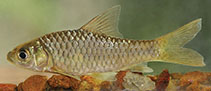
Can be distinguished from all Sri Lankan and peninsular-Indian congeners by having ½4/1/2½ scales in transverse line between mid-dorsal scale row and pelvic-fin origin and lacking any prominent markings on fins and body in both living and preserved examples. Additionally, it is distinguished from the Sri Lankan and peninsular Indian species of Puntius that most closely resemble it as follows: from P. amphibius sensu stricto by having the head length 28.8-31.2% (vs. 26.4-28.3%) SL; eye diameter 7.7-10.2% (vs. 6.6-7.3%) SL; maxillary barbel 3.7-5.3% (vs. 3.1%) SL; and 16+14 vertebrae (vs. 17+14); from P. dorsalis by its smaller size (maximum standard length 72 mm, vs. 133 mm); and lacking any prominent markings on fins and body (vs. black blotches on base of dorsal and caudal fins); and from P. mahecola by its smaller maximum size (up to 73 mm SL, vs. 89 mm SL in P. mahecola), and by lacking a black blotch, larger than eye, across about 3½ scales of the caudal peduncle (Ref. 77057).
Body shape (shape guide): fusiform / normal.
Ciclo de vida e comportamento de acasalamento
Maturidade | Reprodução | Desova | Ovos | Fecundidade | Larvas
Silva, A., K. Maduwage and R. Pethiyagoda, 2008. Puntius kamalika, a new species of barb from Sri Lanka (Teleostei: Cyprinidae). Zootaxa 1824:55-64. (Ref. 77057)
Categoria na Lista Vermelha da IUCN (Ref. 130435: Version 2025-2 (Global))
Ameaça para o homem
Harmless
Utilização humana
Pescarias: sem interesse
Ferramentas
Relatórios especiais
Descarregue XML
Fontes da internet
Estimativas baseadas em modelos
Índice de diversidade filogenética (Ref.
82804): PD
50 = 0.5000 [Uniqueness, from 0.5 = low to 2.0 = high].
Bayesian length-weight: a=0.01259 (0.00566 - 0.02798), b=3.02 (2.85 - 3.19), in cm total length, based on LWR estimates for this Genus-body shape (Ref.
93245).
Nível Trófico (Ref.
69278): 2.7 ±0.1 se; based on size and trophs of closest relatives
Resiliência (Ref.
120179): Elevada, tempo mínimo de duplicação da população menor que 15 meses (Preliminary K or Fecundity.).
Vulnerabilidade da pesca (Ref.
59153): Low vulnerability (10 of 100).
🛈