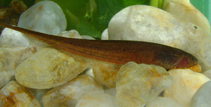
Classificazione / Nomi
Nomi Comuni | Sinonimi | Catalog of Fishes(Genere, Specie) | ITIS | CoL | WoRMS | Cloffa
>
Gymnotiformes (Knifefishes) >
Hypopomidae (Bluntnose knifefishes)
Etymology: Brachyhypopomus: Greek, brachys, eia = short + Greek, hypo = under + Greek, poma, -atos = cover (Ref. 45335); draco: The specific names is from the Greek 'drakon' meaning dragon, in reference to the shape of distal portion of caudal filament in mature males, similar to that illustrated in these imaginary creatures.
Ambiente: milieu / zona climatica / distribuzione batimetrica / gamma di distribuzione
Ecologia
; acqua dolce benthopelagico. Subtropical
South America: Brazil, Uruguay and Paraguay.
Dimensione / Peso / Età
Maturità: Lm ? range ? - ? cm
Max length : 15.2 cm OT maschio/sesso non determinato; (Ref. 76853)
Breve descrizione
Chiavi di identificazione | Morfologia | Morfometria
Raggi anali molli: 155 - 198. Diagnosed from all congeners by the extreme broadening of the distal portion of the caudal filament in males during the reproductive period to form a distinct paddle shaped structure
(vs. moderately broadened distally in Brachyhypopomus pinnicaudatusand Brachyhypopomus brevirostris into paddle-shaped structures, and vs. broadened along most of the length of the caudal filament in Brachyhypopomus occidentalis, Brachyhypopomus diazi, Brachyhypopomus beebei, and Brachyhypopomus janeiroensis). Differs further from other species of the genus by the following characters: caudal filament length 17.3-35.2% of LEA; pectoral fin ray length 4.1-5.8% of LEA; body depth 8.8-12.2% of LEA; snout length 20.7- 30.0% of HL; gape width 9.5- 16.5% of HL; interorbital distance 22.7-35% of HL; branchial aperture 16.5-26% of HL; head width at operculum 48.4-65% of HL; head width at eyes 31.3-45.6% of HL; number of anal fin rays 155-198; upper jaw equal to lower jaw (Ref. 76853).
Body shape (shape guide): elongated.
Facultative air-breathing in the genus (Ref. 126274); Occurs in river edges, slow-moving creeks, lagoons and flooded areas with muddy or sandy bottom and abundant emergent or floating vegetation (Ref. 76853). Length type refers to the length to the end of anal fin (LEA), measured as the distance from tip of snout to posterior end of anal fin base (Ref. 76853).
Ciclo vitale e comportamento di accoppiamento
Maturità | Riproduzione | Deposizione | Uova | Fecondità | Larve
Giora, J., L.R. Malabarba and W. Crampton, 2008. Branchyhypopomus draco, a new sexually dimorphic species of Neotropical electric fish from Southern South America (Gymnotiformes: Hypopomidae). Neotrop. Ichthyol. 6(2):159-168. (Ref. 76853)
Stato della Lista Rossa IUCN (Ref. 130435: Version 2025-2 (Global))
Minaccia per l'uomo
Harmless
Usi umani
Strumenti
Rapporti speciali
Scarica XML
Fonti Internet
Stime basate su modelli
Indice di diversità filogenetica (Fonte Biblio.
82804): PD
50 = 0.5000 [Uniqueness, from 0.5 = low to 2.0 = high].
Bayesian length-weight: a=0.00372 (0.00141 - 0.00980), b=3.06 (2.83 - 3.29), in cm total length, based on LWR estimates for this (Sub)family-body shape (Ref.
93245).
Livello trofico (Fonte Biblio.
69278): 3.1 ±0.4 se; based on size and trophs of closest relatives
Vulnerabilità della pesca (Ref.
59153): Low vulnerability (10 of 100).
🛈