البيئة: الوسط / المنطقة المناخية / نطاق العمق / نطاق التوزيع
البيئة
بحري مرتبطة بالشعاب; غير مهاجرة; نطاق العمق 0 - 40 m (Ref. 37816), usually 1 - 15 m (Ref. 90102). Tropical; 24°C - 28°C; 29°N - 34°S, 33°E - 122°W (Ref. 5222)
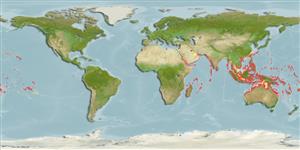
Indo-Pacific: Red Sea to Durban, South Africa and eastward to French Polynesia and the Pitcairn group, north to the Ryukyu and Ogasawara islands, south to northern Australia and Lord Howe Island. May be confused with Cephalopholis cyanostigma.
الطول عند النضج الأول / الحجم / وزن / العمر
النضج: Lm ?, range 22 - ? cm
Max length : 60.0 cm TL ذكر/ مختلط الجنس; (Ref. 11441); common length : 40.0 cm TL ذكر/ مختلط الجنس; (Ref. 5450)
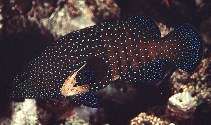
الأشواك الظهرية (المجموع) : 9; الأشعة الظهرية الناعمة (المجموع) : 15 - 17; شوكة شرجية: 3; أشعه شرجية لينه: 9. This species is distinguished by the following characters: greatest body depth 2.7-3.3 in SL; dorsal soft rays usually 16-17; pectoral fin rays usually 16-17; longitudinal scale series 95-110; caudal fin rounded; pelvic fins short , 1.9-2.4 in head length. Colour of body dark brown, with small black-edged blue spots; often with 5-6 pale bars on rear part of body and a large pale area over the chest (abdominal/pectoral region) (Ref. 39231, 90102).
Body shape (shape guide): fusiform / normal; Cross section: oval.
A generally common species (Ref. 9710). Adults are benthic and benthopelagic in a variety of coral habitats (Ref. 58534, 58302) from tide pools to depths of at least 40 m; preferring the 1 to 10 m reef zone. Juveniles prefer shallow, protected coral thickets (Ref. 37816). Mature adults are found in social units comprising up to 12 adults, including 1 dominant male and each group occupies a specific area (up to 2,000 sq. m.) that is defended by the territorial male and subdivided into secondary territories, each inhabited by a single female (Ref. 39231). At times, they may also be solitary (Ref. 90102). Adults feed mainly on fishes (75-95%) and to a lesser extent on crustaceans. In the Red Sea, they feed early in the morning and late afternoon (Ref. 6775) but in Madagascar, they appear to feed more at night (Ref. 6774). They are implicated in ciguatera at some of the islands in the Pacific region. They can be seen in Hong Kong live fish markets (Ref. 27253). They are important to artisanal fisheries throughout the Indo-West Pacific region and often caught with hook-and-line, spear, and in traps (Ref. 39231). Minimum depth reported taken from Ref. 128797.
دورة الحياة وسلوك التزاوج
النضج | التكاثر | وضع البيض | بيض | الخصوبة | اليرقات
Heemstra, P.C. and J.E. Randall, 1993. FAO Species Catalogue. Vol. 16. Groupers of the world (family Serranidae, subfamily Epinephelinae). An annotated and illustrated catalogue of the grouper, rockcod, hind, coral grouper and lyretail species known to date. Rome: FAO. FAO Fish. Synop. 125(16):382 p. (Ref. 5222)
حالة القائمة الحمراء للاتحاد الدولي لحفظ الطبيعة والموارد الطبيعية (Ref. 130435: Version 2025-2 (Global))
خطر للأنسان
Reports of ciguatera poisoning (Ref. 4690)
استخدامات بشرية
مصائد: تجاري; لعبة سمكه: نعم; حوض مائي: تجاري
أدوات
تقارير خاصة
تنزيل XML
مصادر علي الأنترنت
تقديرات تستند إلى النماذج
درجة الحرارة المفضلة (مرجع
123201): 24.9 - 29.3, mean 28.4 °C (based on 3533 cells).
مؤشر التنوع الشُعبي الوراثي (مرجع
82804): PD
50 = 0.5000 [Uniqueness, from 0.5 = low to 2.0 = high].
Bayesian length-weight: a=0.01230 (0.01070 - 0.01414), b=3.05 (3.02 - 3.08), in cm total length, based on LWR estimates for this species (Ref.
93245).
مستوى غذائي (مرجع
69278): 4.5 ±0.0 se; based on diet studies.
المرونه (مرجع
120179): وسيط, الحد الزمني الأدني لتضاعف عدد أفراد المجتمع 1.4-4.4 سنة (Preliminary K or Fecundity.).
ضعف الصيد (Ref.
59153): Moderate vulnerability (44 of 100).
🛈
قابلية التأثر بالمناخ (Ref.
125649): High to very high vulnerability (72 of 100).
🛈
المغذيات (Ref.
124155): Calcium = 35.8 [20.4, 60.7] mg/100g; Iron = 0.489 [0.277, 0.892] mg/100g; Protein = 18.7 [16.9, 20.4] %; Omega3 = 0.152 [0.098, 0.235] g/100g; Selenium = 35.2 [19.9, 59.3] μg/100g; VitaminA = 148 [53, 474] μg/100g; Zinc = 0.673 [0.495, 1.087] mg/100g (wet weight); based on
nutrient studies.