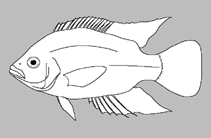
Classificação / Nomes
Nomes comuns | Sinônimos | Catalog of Fishes(Gênero, Espécies) | ITIS | CoL | WoRMS | Cloffa
>
Cichliformes (Cichlids, convict blennies) >
Cichlidae (Cichlids) > Cichlinae
Etymology: Crenicichla: Latin, crenulatus = cut, clipped + Greek, kichle = wrasse (Ref. 45335); empheres: Name from Greek meaning similar, alludes to its similarity with C. jurubi, a species occurring in the same drainage; an adjective.
Meio ambiente: milieu / Zona climática / intervalo de profundidade / faixa de distribuição
Ecologia
; Água doce pelágico(a,os,as). Tropical
South America: Brazil.
Tamanho / Peso / Idade
Maturidade: Lm ? range ? - ? cm
Max length : 14.1 cm SL macho/indeterminado; (Ref. 75870)
Descrição suscinta
Chaves de identificação | Morfologia | Morfometria
This species is distinguished from other species of the C. missioneira group by having 6-8 slightly elongate blotches along middle portion of the body flank, below the upper lateral line scale row, no lateral band, numerous spots scattered over back, (sometimes forming a reticulated pattern) and sides in males, and an isognathous mouth. It is most similar to
C. igara and C. jurubi in color pattern, but both males and females of the latter species show the same scattered spots including those on the head and opercle vs. none in females and males of Crenicichla empheres which has the spots confined to the lateral of body. Other differences, C. jurubi may have the last three or four blotches contiguous without lighter space between them and/or mixing with the spotted pattern of the body) and
C. igara has prognathous mouth and no ocellated spot on the dorsal fin in females (Ref. 75870).
Body shape (shape guide): elongated.
The specimens were collected above a major waterfall in the rio Chapecó. Although many
other localities were explored downstream and in the rio Uruguay itself, no additional specimens were captured. Stomach contents of one female specimen (9.32 cm SL, MCP 40176) contain aquatic insect larvae (Ref. 75870).
Ciclo de vida ou comportamento de acasalamento
Maturidade | Reprodução | Desova | Ovos | Fecundidade | Larvas
Lucena, C.A.S. de, 2007. Two new species of the genus Crenicichla Heckel, 1840 from the upper rio Uruguay drainage (Perciformes: Cichlidae). Neotrop. Ichthyol. 5(4):449-456. (Ref. 75870)
Status na Lista Vermelha da UICN (Ref. 130435: Version 2025-2 (Global))
Ameaça para os humanos
Harmless
Uso pelos humanos
Ferramentas
Relatórios especiais
Baixar XML
Fontes da internet
Estimativas baseadas em modelos
Índice de diversidade filogenética (Ref.
82804): PD
50 = 0.5000 [Uniqueness, from 0.5 = low to 2.0 = high].
Bayesian length-weight: a=0.00741 (0.00332 - 0.01655), b=3.11 (2.94 - 3.28), in cm total length, based on LWR estimates for this Genus-body shape (Ref.
93245).
Nível Trófico (Ref.
69278): 3.2 ±0.5 se; based on size and trophs of closest relatives
Resiliência (Ref.
120179): Elevada, tempo mínimo de duplicação da população menor que 15 meses (Preliminary K or Fecundity.).
Vulnerabilidade da pesca (Ref.
59153): Low vulnerability (10 of 100).
🛈