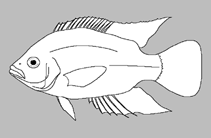
Classification / Noms
Noms communs | Synonymes | Catalog of Fishes(Genre, Espèce) | ITIS | CoL | WoRMS | Cloffa
>
Cichliformes (Cichlids, convict blennies) >
Cichlidae (Cichlids) > Cichlinae
Etymology: Crenicichla: Latin, crenulatus = cut, clipped + Greek, kichle = wrasse (Ref. 45335); empheres: Name from Greek meaning similar, alludes to its similarity with C. jurubi, a species occurring in the same drainage; an adjective.
Environnement : milieu / zone climatique / profondeur / gamme de distribution
Écologie
; eau douce pélagique. Tropical
South America: Brazil.
Taille / Poids / Âge
Maturité: Lm ? range ? - ? cm
Max length : 14.1 cm SL mâle / non sexé; (Ref. 75870)
Description synthétique
Clés d'identification | Morphologie | Morphométrie
This species is distinguished from other species of the C. missioneira group by having 6-8 slightly elongate blotches along middle portion of the body flank, below the upper lateral line scale row, no lateral band, numerous spots scattered over back, (sometimes forming a reticulated pattern) and sides in males, and an isognathous mouth. It is most similar to
C. igara and C. jurubi in color pattern, but both males and females of the latter species show the same scattered spots including those on the head and opercle vs. none in females and males of Crenicichla empheres which has the spots confined to the lateral of body. Other differences, C. jurubi may have the last three or four blotches contiguous without lighter space between them and/or mixing with the spotted pattern of the body) and
C. igara has prognathous mouth and no ocellated spot on the dorsal fin in females (Ref. 75870).
Body shape (shape guide): elongated.
The specimens were collected above a major waterfall in the rio Chapecó. Although many
other localities were explored downstream and in the rio Uruguay itself, no additional specimens were captured. Stomach contents of one female specimen (9.32 cm SL, MCP 40176) contain aquatic insect larvae (Ref. 75870).
Cycle de vie et comportement reproducteur
Maturité | Reproduction | Frai | Œufs | Fécondité | Larves
Lucena, C.A.S. de, 2007. Two new species of the genus Crenicichla Heckel, 1840 from the upper rio Uruguay drainage (Perciformes: Cichlidae). Neotrop. Ichthyol. 5(4):449-456. (Ref. 75870)
Statut dans la liste rouge de l'IUCN (Ref. 130435: Version 2025-2 (Global))
Menace pour l'homme
Harmless
Utilisations par l'homme
Outils
Articles particuliers
Télécharger en XML
Sources Internet
Estimations basées sur des modèles
Indice de diversité phylogénétique (Réf.
82804): PD
50 = 0.5000 [Uniqueness, from 0.5 = low to 2.0 = high].
Bayesian length-weight: a=0.00741 (0.00332 - 0.01655), b=3.11 (2.94 - 3.28), in cm total length, based on LWR estimates for this Genus-body shape (Ref.
93245).
Niveau trophique (Réf.
69278): 3.2 ±0.5 se; based on size and trophs of closest relatives
Résilience (Réf.
120179): Haut, temps minimum de doublement de population inférieur à 15 mois (Preliminary K or Fecundity.).
Vulnérabilité de la pêche (Ref.
59153): Low vulnerability (10 of 100).
🛈