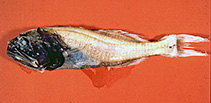
การจำแนกประเภท / ชื่อ
ชื่อสามัญ | ชื่อพ้อง | Catalog of Fishes(สกุล, ชนิด) | ITIS | CoL | WoRMS | Cloffa
>
Beryciformes (Sawbellies) >
Stephanoberycidae (Pricklefishes)
Etymology: Abyssoberyx: Named for the great depth from which this fish was trawled; levisquamosus: Named for the smoothness of its scales.
สิ่งแวดล้อม : สิ่งแวดล้อม / เขตภูมิอากาศ / ระดับความลึก / ระยะการกระจายสินค้า
นิเวศวิทยา
เกี่ยวกับทะเล,น้ำเค็ม สัตว์ผิวน้ำในเขตน้ำลึก; ระดับความลึก ? - 4565 m (Ref. 75592). Deep-water; 22°N - 20°N, 21°W - 31°W (Ref. 75592)
Eastern Central Atlantic. High Seas only.
ขนาด / น้ำหนัก / อายุ
วัยเจริญพันธุ์: Lm ? range ? - ? cm
Max length : 16.8 cm SL เพศผู้/กระเทย; (Ref. 75592)
คำอธิบายสั้นๆ
เครื่องมือที่ใช้ในการแยกชนิดสัตว์,สิ่งมีชีวิตออกจากกัน | สัณฐานวิทยา | ความยาวต่างๆ
สัตว์มีกระดูกสันหลัง: 32 - 34. This species have the following characters: cycloid scales; dorsal fin spines 1-2; gill rakers 5-7 + 14-15 (Ref. 75592).
Body shape (shape guide): fusiform / normal.
This species is caught by bottom trawls (epibenthic sledge and semi-balloon otter trawl). The type series were collected at a single station where the terrain at these abyssal depths (4490-4640 m) is characterized by a complex topography of undulations, some hundreds of meters in height and where substratum is firm with very low megafaunal biomass. Lack of a rich benthic invertebrate fauna contrasts with the abundance and diversity of the fish fauna sampled. Also, this species occurred among 22 other species of Synaphobranchidae (1 species), Alepocephalidae (2), Ipnopidae (4), Bathysauridae (1), Ophidiidae (8), Aphyonidae (3) and Macrouridae (3). In overall abundance, it ranked fourth, equal to the ophidioid, Porogadus sp. (10 specimens), but less abundant than the ipnopids, Bathypterois longipes Günther, 1878 (24) and Bathymicrops regis Hjort & Koefoed, 1912 (28) and the ophidioid, Bathyonus laticeps (Günther, 1878) (51). Specimens (3) were examined internally, all females (15.2, 15.5, 16.8 cm SL), with ovaries in varying stages of yolk formation. Some 3-4 generations of oocytes were present in the ovaries. The ovaries of the 15.5 cm SL specimen were the most mature, with the most advanced generation (estimated at some thousands of ova) being c. 1 mm in diameter and containing a large oil globule. Also, intestinal contents of this specimen were chitinous remains, while that of the holotype bore a heavy infestation of cestode worms only (Ref. 75592).
วงจรชีวิตและพฤติกรรมการผสมพันธุ์
วัยเจริญพันธุ์ | การสืบพันธุ์ | การวางไข่ | เซลสืบพันธ์ของเพศเมีย(ไข่) | ความดกของไข่ | ตัวอ่อน
Merrett, N.R. and J.A. Moore, 2005. A new genus and species of deep demersal fish (Teleostei: Stephanobercidae) from the tropical eastern North Atlantic. J. Fish Biol. 67(6):1699-1710. (Ref. 75592)
สถานะบัญชีแดงของ IUCN (Ref. 130435: Version 2025-2 (Global))
ภัยคุกคามต่อมนุษย์
Harmless
การใช้ของมนุษย์
การประมง: bycatch
เครื่องมือ
รายงานพิเศษ
ดาวน์โหลด XML
แหล่งที่มาจากอินเตอร์เน็ต
การประมาณค่าตามแบบจำลอง
ดัชนีความหลากหลายทางวิวัฒนาการ (อ้างอิง
82804): PD
50 = 1.0625 [Uniqueness, from 0.5 = low to 2.0 = high].
Bayesian length-weight: a=0.01122 (0.00514 - 0.02450), b=3.04 (2.87 - 3.21), in cm total length, based on all LWR estimates for this body shape (Ref.
93245).
ระดับชั้นอาหาร (อ้างอิง
69278): 3.4 ±0.5 se; based on size and trophs of closest relatives
ความสามารถในการกลับคืนสู่ปกติ (อ้างอิง
120179): ขนาดกลาง, เวลาต่ำสุดที่จะทำให้ประชากรเพิ่มขึ้นเป็น 2 เท่าใช้เวลา 1.4 - 4.4 ปี (Preliminary K or Fecundity.).
ความเสี่ยงต่อการตกปลา (Ref.
59153): Low vulnerability (11 of 100).
🛈