Ταξινόμηση / Ονόματα
Κοινά ονόματα | Συνώνυμα | Catalog of Fishes(Γένος, Είδη) | ITIS | CoL | WoRMS | Cloffa
>
Beryciformes (Sawbellies) >
Stephanoberycidae (Pricklefishes)
Etymology: Abyssoberyx: Named for the great depth from which this fish was trawled; levisquamosus: Named for the smoothness of its scales.
Περιβάλλον: περιβάλλον / κλιματική ζώνη / εύρος βάθους / εύρος διανομής
Οικολογία
Θαλασσινό(ά) βαθυπελαγικό(ς); εύρος βάθους ? - 4565 m (Ref. 75592). Deep-water; 22°N - 20°N, 21°W - 31°W (Ref. 75592)
Eastern Central Atlantic. High Seas only.
Μέγεθος / Βάρος / Ηλικία
Γεννητική Ωρίμανση: Lm ? range ? - ? cm
Max length : 16.8 cm SL αρσενικό/απροσδιόριστο; (Ref. 75592)
Σύντομη περιγραφή
Κλείδες προσδιορισμού | Μορφολογία | Μορφομετρία
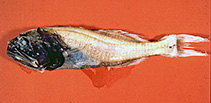
Σπόνδυλοι: 32 - 34. This species have the following characters: cycloid scales; dorsal fin spines 1-2; gill rakers 5-7 + 14-15 (Ref. 75592).
Body shape (shape guide): fusiform / normal.
This species is caught by bottom trawls (epibenthic sledge and semi-balloon otter trawl). The type series were collected at a single station where the terrain at these abyssal depths (4490-4640 m) is characterized by a complex topography of undulations, some hundreds of meters in height and where substratum is firm with very low megafaunal biomass. Lack of a rich benthic invertebrate fauna contrasts with the abundance and diversity of the fish fauna sampled. Also, this species occurred among 22 other species of Synaphobranchidae (1 species), Alepocephalidae (2), Ipnopidae (4), Bathysauridae (1), Ophidiidae (8), Aphyonidae (3) and Macrouridae (3). In overall abundance, it ranked fourth, equal to the ophidioid, Porogadus sp. (10 specimens), but less abundant than the ipnopids, Bathypterois longipes Günther, 1878 (24) and Bathymicrops regis Hjort & Koefoed, 1912 (28) and the ophidioid, Bathyonus laticeps (Günther, 1878) (51). Specimens (3) were examined internally, all females (15.2, 15.5, 16.8 cm SL), with ovaries in varying stages of yolk formation. Some 3-4 generations of oocytes were present in the ovaries. The ovaries of the 15.5 cm SL specimen were the most mature, with the most advanced generation (estimated at some thousands of ova) being c. 1 mm in diameter and containing a large oil globule. Also, intestinal contents of this specimen were chitinous remains, while that of the holotype bore a heavy infestation of cestode worms only (Ref. 75592).
Κύκλος ζωής και συμπεριφορά ζευγαρώματος
Γεννητική Ωρίμανση | Αναπαραγωγή | Γεννοβολία | Αβγά | Γονιμότητα | Προνύμφες
Merrett, N.R. and J.A. Moore, 2005. A new genus and species of deep demersal fish (Teleostei: Stephanobercidae) from the tropical eastern North Atlantic. J. Fish Biol. 67(6):1699-1710. (Ref. 75592)
Κατάσταση Κόκκινου Καταλόγου IUCN (Ref. 130435: Version 2025-2 (Global))
Απειλή για τον άνθρωπο
Harmless
Ανθρώπινες χρήσεις
αλιεία: bycatch
Εργαλεία
Ειδικές εκθέσεις
Λήψη XML
Διαδικτυακές πηγές
Εκτιμήσεις βάσει μοντέλων
Δείκτης φυλογενετικής ποικιλότητας (Αναφ.
82804): PD
50 = 1.0625 [Uniqueness, from 0.5 = low to 2.0 = high].
Bayesian length-weight: a=0.01122 (0.00514 - 0.02450), b=3.04 (2.87 - 3.21), in cm total length, based on all LWR estimates for this body shape (Ref.
93245).
Τροφικό Επίπεδο (Αναφ.
69278): 3.4 ±0.5 se; based on size and trophs of closest relatives
Ελαστικότητα (Αναφ.
120179): Μεσαίο(α), ελάχιστος χρόνος για διπλασιασμό πληθυσμού 1,4 - 4,4 έτη (Preliminary K or Fecundity.).
Ευπάθεια στην αλιεία (Ref.
59153): Low vulnerability (11 of 100).
🛈