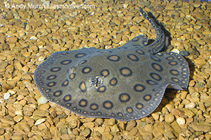
Elasmobranquios (tiburones y rayas) (sharks and rays) >
Myliobatiformes (Stingrays) >
Potamotrygonidae (River stingrays) > Potamotrygoninae
Etymology: Potamotrygon: Greek, potamos = river + Greek, trygon = a sting ray (Ref. 45335).
More on authors: Müller & Henle.
Taxonomic Remarks
Authorship of species is credited to Müller & Henle (1841) and not Naterrer (who collected the type specimen) as in Rosa (1985a). A widespread species that may require further subdivision after more study. Studies of its reproductive biology indicate that females attain sexual maturity between 24 and 32 cm DW (males between 20 and 30 cm DW), and may produce from three to 21 embryos per gestation (Achenbach & Achencbach, 1976) or only six or seven (Thorson et al., 1983b; these differences may be populational). Larger specimens may weigh 10 kg. This species has been captively bred in aquaria, but is still the most comercially imported species by the aquarium industry. Additional references: Bertin (1939), Castex & Castello (1970b), Achenbach & Achenbach (1976), Thorson et al. (1983b), Sérét & McEachran (1986), Ortega & Vari (1986), Paepke & Schmidt (1988), Barriga (1991), Compagno & Cook (1995), Lasso et al. (1997a), Ferreira et al. (1998), Britski et al. (1999).
Entorno: milieu / zona climática / rango de profundidad / gama de distribución
Ecología
; agua dulce bentopelágico; pH range: 5.0 - 6.0; dH range: 10 - ?; potamodromo (Ref. 51243). Tropical; 24°C - 26°C (Ref. 2060)
South America: Uruguay, Paraná-Paraguay, Orinoco, and Amazon River basins.
Tamaño / Peso / Edad
Madurez: Lm ? range ? - ? cm
Max length : 50.0 cm WD macho / no sexado; (Ref. 36687); peso máximo publicado: 34.2 kg (Ref. 85107)
Found in freshwater rivers. It is an extremely dangerous species. Maximum length reported in Axelrod et al., 1991 (Ref. 6398) is 100 cm TL.
Ciclo vital y comportamiento de apareamiento
Madurez | Reproducción | Puesta | Huevos | Fecundidad | Larva
16 pups were born by one female in captivity (Ref. 57489).
Ortega, H. and R.P. Vari, 1986. Annotated checklist of the freshwater fishes of Peru. Smithson. Contrib. Zool. (437):1-25. (Ref. 6329)
Situación en la Lista Roja de la UICN (Ref. 130435: Version 2025-2 (Global))
Amenaza para el ser humano
Traumatogenic (Ref. 4716)
Usos humanos
Pesquerías: escaso valor comercial; pesca deportiva: si; Acuario: Acuarios públicos
Herramientas
Informes especiales
Descargar XML
Fuentes de Internet
Estimaciones basadas en modelos
Índice de diversidad filogenética (Referencia
82804): PD
50 = 0.5000 [Uniqueness, from 0.5 = low to 2.0 = high].
Bayesian length-weight: a=0.01000 (0.00244 - 0.04107), b=3.04 (2.81 - 3.27), in cm total length, based on all LWR estimates for this body shape (Ref.
93245).
Nivel trófico (Referencia
69278): 3.2 ±0.4 se; based on size and trophs of closest relatives
Generation time: 6.5 ( na - na) years. Estimated as median ln(3)/K based on 2
growth studies.
Resiliencia (Referencia
120179): Bajo, población duplicada en un tiempo mínimo de 4.5-14 años (Fec=16).
Vulnerabilidad pesquera (Ref.
59153): Moderate to high vulnerability (54 of 100).
🛈