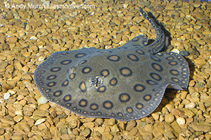
Elasmobranchi (squali e razze) (sharks and rays) >
Myliobatiformes (Stingrays) >
Potamotrygonidae (River stingrays) > Potamotrygoninae
Etymology: Potamotrygon: Greek, potamos = river + Greek, trygon = a sting ray (Ref. 45335).
More on authors: Müller & Henle.
Taxonomic Remarks
Authorship of species is credited to Müller & Henle (1841) and not Naterrer (who collected the type specimen) as in Rosa (1985a). A widespread species that may require further subdivision after more study. Studies of its reproductive biology indicate that females attain sexual maturity between 24 and 32 cm DW (males between 20 and 30 cm DW), and may produce from three to 21 embryos per gestation (Achenbach & Achencbach, 1976) or only six or seven (Thorson et al., 1983b; these differences may be populational). Larger specimens may weigh 10 kg. This species has been captively bred in aquaria, but is still the most comercially imported species by the aquarium industry. Additional references: Bertin (1939), Castex & Castello (1970b), Achenbach & Achenbach (1976), Thorson et al. (1983b), Sérét & McEachran (1986), Ortega & Vari (1986), Paepke & Schmidt (1988), Barriga (1991), Compagno & Cook (1995), Lasso et al. (1997a), Ferreira et al. (1998), Britski et al. (1999).
Ambiente: milieu / zona climatica / distribuzione batimetrica / gamma di distribuzione
Ecologia
; acqua dolce benthopelagico; pH range: 5.0 - 6.0; dH range: 10 - ?; potamodromo (Ref. 51243). Tropical; 24°C - 26°C (Ref. 2060)
South America: Uruguay, Paraná-Paraguay, Orinoco, and Amazon River basins.
Dimensione / Peso / Età
Maturità: Lm ? range ? - ? cm
Max length : 50.0 cm WD maschio/sesso non determinato; (Ref. 36687); peso massimo pubblicato: 34.2 kg (Ref. 85107)
Found in freshwater rivers. It is an extremely dangerous species. Maximum length reported in Axelrod et al., 1991 (Ref. 6398) is 100 cm TL.
Ciclo vitale e comportamento di accoppiamento
Maturità | Riproduzione | Deposizione | Uova | Fecondità | Larve
16 pups were born by one female in captivity (Ref. 57489).
Ortega, H. and R.P. Vari, 1986. Annotated checklist of the freshwater fishes of Peru. Smithson. Contrib. Zool. (437):1-25. (Ref. 6329)
Stato della Lista Rossa IUCN (Ref. 130435: Version 2025-2 (Global))
Minaccia per l'uomo
Traumatogenic (Ref. 4716)
Usi umani
Pesca: scarso interesse commerciale; Pesce da pesca sportiva: si; Acquario: Acquari pubblici
Strumenti
Rapporti speciali
Scarica XML
Fonti Internet
Stime basate su modelli
Indice di diversità filogenetica (Fonte Biblio.
82804): PD
50 = 0.5000 [Uniqueness, from 0.5 = low to 2.0 = high].
Bayesian length-weight: a=0.01000 (0.00244 - 0.04107), b=3.04 (2.81 - 3.27), in cm total length, based on all LWR estimates for this body shape (Ref.
93245).
Livello trofico (Fonte Biblio.
69278): 3.2 ±0.4 se; based on size and trophs of closest relatives
Generation time: 6.5 ( na - na) years. Estimated as median ln(3)/K based on 2
growth studies.
Resilienza (Fonte Biblio.
120179): Basso, tempo minimo di raddoppiamento della popolazione 4.5 - 14 anni (Fec=16).
Vulnerabilità della pesca (Ref.
59153): Moderate to high vulnerability (54 of 100).
🛈